
Transparent PET bottles are widely used in bottled-water, beverage, edible-oil, daily-chemical and cosmetic packaging industries for their light weight, high transparency and flexible molding performance. With growing demands for product traceability and automated packaging, the marking quality of production dates, batch numbers, QR codes and other information has become a major concern for manufacturers.
Compared with traditional inkjet coding, laser coding forms permanent marks directly on bottle surfaces without ink or solvents. Nevertheless, transparent PET features high light transmittance, thin bottle walls and high sensitivity to thermal effects. Therefore, laser processing is far more complex than marking on ordinary paper cartons or metals.
A core challenge for laser coding processes is to generate clear, durable marks on transparent PET bottles while avoiding bottle deformation, wall-thickness loss or even perforation.
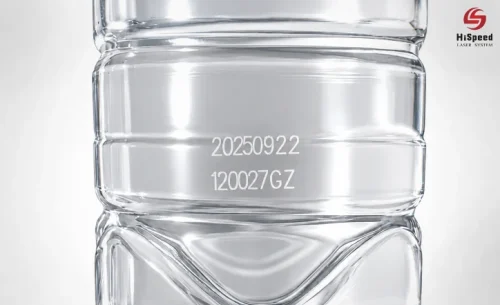
1. What are the differences between laser coding and traditional inkjet coding?
Traditional inkjet coding remains widely adopted for PET-bottle packaging production thanks to mature technology, low initial equipment investment and good mark contrast. Dark-colored ink can deliver distinct date and batch codes on transparent bottles. However, the equipment requires continuous refilling of ink and consumables, together with regular nozzle cleaning. The wear resistance and adhesion of marks are also subject to ink type, bottle-surface conditions and service environments.
By contrast, laser coding creates marks through interactions between laser beams and material surfaces. It eliminates ink, solvents and the associated consumable replacement and maintenance work. Since marks are formed directly on the material surface, they are less prone to rubbing-off compared with some ink-based marks.
2. Why is laser coding more difficult for transparent PET bottles?
The primary challenge for transparent PET bottles lies in mark contrast.
Unlike opaque materials, transparent PET lacks a stable colored background. Surface modifications produced by some laser processes may show low visibility. Even if marks are visible to the naked eye, transmitted light, liquid color or changing lighting conditions may hinder character recognition.
Bottle-wall thickness is another critical concern.
Many beverage packages adopt lightweight designs to cut material consumption and logistics costs, resulting in relatively thin bottle walls. Excessive laser power or local heat accumulation may cause surface melting, indentation and deformation. In severe cases, micro-holes may occur and compromise packaging sealing and performance.
Accordingly, higher mark clarity cannot be achieved simply by increasing power or deepening engraving. A balance must be struck between material reaction and structural integrity.
For manufacturers, qualified laser codes on PET bottles should be not only legible, but also free of adverse impacts on normal bottle performance.
3. UV laser vs CO₂ laser: which suits transparent PET better?
Multiple laser technologies can be applied to transparent PET bottles, yet processing outcomes depend heavily on laser wavelength, material formulation and bottle-wall thickness.
UV laser: fine processing with low thermal impact
UV lasers typically operate at a wavelength of 355 nm, featuring fine laser spots and small heat-affected zones. They fit applications with high requirements for processing precision and material protection.
For thin-walled PET bottles, properly adjusted laser energy, scanning speed and focal position can produce sharp marks on target surfaces while minimizing local heat buildup.
Even so, UV lasers do not deliver zero thermal impact. PET formulations, additives and surface conditions will alter marking results, so real-sample testing is still required.
CO₂ laser: different wavelengths trigger different material responses
CO₂ lasers are also important marking tools for PET packaging, yet not all CO₂ lasers perform identically.
Conventional 10.6 μm CO₂ lasers create visible marks via surface melting. Boosting processing depth for higher contrast raises risks of bottle-wall damage.
Certain 9.3 μm CO₂ lasers, specially optimized for PET applications, generate pale or frosted marks through surface micro-foaming. Under suitable conditions, they achieve good visibility with reduced deep erosion.
There is no absolute winner between UV and CO₂ lasers. Equipment selection should comprehensively consider actual bottle profiles, PET formulations, marking specifications and production line speeds.
4. How to guarantee coding consistency on high-speed production lines?
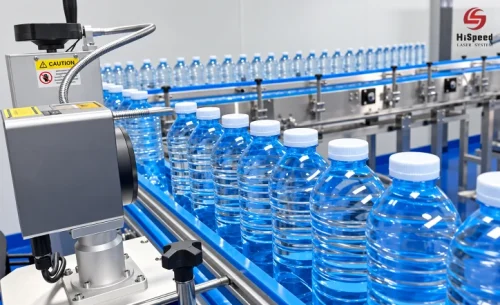
PET bottles receive date and batch marks on continuous filling, conveying and packaging lines. Equipment must produce clear patterns while maintaining stable marking positions and quality as bottles move.
Hispeed Laser’s Flying Laser Coding System uses sensors to detect product positions and synchronize processing with conveyor speed, with no need to halt production.
Furthermore, transparent bottle backgrounds affect visual performance. Identical marks show different readability on empty bottles, water-filled bottles and dark-beverage bottles.
Therefore, equipment tests should replicate real-world production conditions as much as possible, including bottle status, conveying speed, marking position and inspection environment.
For high-speed packaging lines, continuous, stable and legible coding across mass production matters more than single-shot marking speed.
5. How to achieve both mark clarity and bottle integrity?
Coding quality for transparent PET bottles cannot be judged solely from sample photos. Validation should comply with actual packaging requirements.
First, verify character contrast, edge completeness and QR-code readability. For automated traceability lines, use actual scanning devices to test mark readability under varied conditions.
Second, inspect surfaces for obvious indentation, melting or deformation. For lightweight thin-walled bottles, perform sealing, pressure-resistance or other relevant performance tests when necessary to confirm laser processing does not impair packaging functions.
In addition, PET materials from different suppliers, recycled-material ratios, bottle-wall thickness and molding processes all influence laser responses. Identical appearances do not guarantee identical marking results under the same set of parameters.
Stable laser coding processes require comprehensive control over laser wavelength, energy density, scanning speed and focal position. Mass-production-ready processing parameters should be finalized via sample testing.
6. Hispeed Laser’s laser coding solution for transparent PET bottles
Hispeed Laser offers UV flying laser coding solutions for bottled-water, beverage, daily-chemical and cosmetic packaging applications.
For transparent PET bottles and some heat-sensitive plastic packages, 355 nm UV laser sample tests are available. Processing parameters are optimized according to bottle-wall thickness and material properties to maximize mark legibility while minimizing thermal impact.
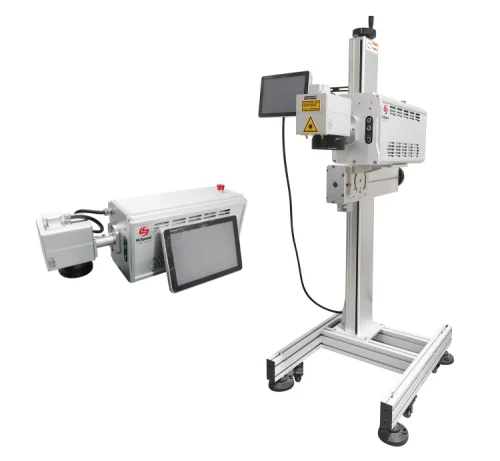
For automated production, UV flying laser systems can integrate with existing conveyor lines. Equipped with sensors, encoders, fume extraction and other auxiliary devices, they mark production dates, batch numbers, QR codes and other information on moving products.
For packaging enterprises seeking to upgrade existing inkjet equipment, Hispeed Laser conducts assessments on mark clarity, thermal effects and mass-processing stability based on real PET-bottle samples, production cycle times and line conditions, and helps customers select suitable laser solutions.
Заключение
Against the backdrop of lightweight packaging and high-speed automated manufacturing, packaging manufacturers need to pay closer attention to matching laser technologies, material properties and real-line conditions.
A qualified laser coding solution delivers codes that are visible and scannable, while preserving bottles’ structural strength and functional performance.
For PET-bottle manufacturers and packaging enterprises, establishing stable and reliable processing workflows through real-sample testing is the key to high-quality marking and continuous mass production。