
As demand continues to grow for metal product traceability, industrial component identification, promotional product customization, and automated production, fiber lasers are becoming an increasingly important choice for manufacturers. Compared with screen printing, pad printing, inkjet coding, labeling, or mechanical engraving, fiber laser processing is non-contact and requires no ink, printing plates, or cutting tools. On suitable materials, it can produce clear, stable, permanent marks and engravings that are easy to integrate into automated systems.
In 2026, fiber laser applications are no longer limited to simple logo engraving on metal. They are expanding into more specialized production scenarios, including QR code traceability, serial number marking, deep engraving, curved-surface processing, 360° rotary engraving, CCD vision positioning, and on-the-fly marking.

Why Does Demand for Fiber Laser Marking Continue to Grow?
Fiber lasers typically use a wavelength of 1064 nm and deliver excellent marking results on stainless steel, aluminum alloys, carbon steel, copper, brass, titanium alloys, and certain engineering plastics. For customers seeking permanent identification, product traceability, and efficient production, fiber lasers provide a more suitable solution to the following common challenges:
- Traditional printing can wear or peel off and cannot meet long-term traceability requirements.
- Metal parts require permanent identification such as QR codes, serial numbers, batch numbers, and barcodes.
- Small components require higher marking accuracy and clearer characters.
- High-mix, low-volume orders require fast switching between content and graphics.
- Cylindrical, curved, or irregular metal products require more flexible marking methods.
- Automated production lines require high-speed marking at a stable cycle time while reducing manual operation.
In practical applications, higher power is not always better. Material type, surface treatment, graphic area, marking depth, product shape, and the desired final effect all influence the most suitable machine configuration.
What Materials and Applications Are Suitable for Fiber Lasers?
Fiber lasers are most commonly used for marking, engraving, deep engraving, and traceability code processing on metal materials. Sample testing should be conducted according to the actual material, surface treatment, and processing objective of each product.
Typical Materials and Application Scenarios
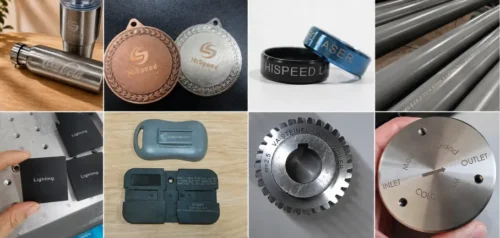
- Metal products: Logos, text, serial numbers, QR codes, barcodes, and branding on stainless steel, aluminum alloys, carbon steel, copper, brass, titanium alloys, and other metals.
- Promotional products: Engraving on metal tumblers, sports bottles, metal pens, metal business card cases, keychains, commemorative coins, and corporate metal gifts.
- Industrial components: Traceability marking on hardware tools, bearings, gears, molds, mechanical parts, automotive components, and metal nameplates.
- Electronics and connectors: Marking on connectors, shielding covers, electronic housings, metal terminals, battery components, and small precision metal parts.
- Medical devices: Model numbers, batch numbers, and traceability codes on stainless steel surgical instruments, medical tools, medical equipment parts, and metal consumables.
Note: Fiber lasers are mainly suitable for metals and certain engineering plastics. They are not suitable for most non-metallic materials such as wood, leather, paper, and acrylic. For mirror-finished metals, highly reflective materials, deep engraving requirements, or products with special surface treatments, sample testing is recommended to confirm the final marking result, depth, and contrast.
How to Choose Different Laser Power?
Power selection should take processing speed, marking area, engraving depth, material type, and continuous production requirements into account. The following provides a practical reference for common power levels.
30W Fiber Laser Marking Machine
A 30W fiber laser marking machine is suitable for standard metal marking, light engraving, and low-volume customization. For stainless steel, aluminum alloys, carbon steel, metal nameplates, metal pens, electronic housings, and small hardware parts, 30W is generally sufficient for standard logos, text, serial numbers, QR codes, and simple graphics.
Suitable for: Sample testing, low-volume customization, basic metal marking, metal gifts, and traceability marking on standard industrial parts.
60W Fiber Laser Marking Machine
A 60W fiber laser marking machine offers a better balance of speed, marking depth, and material adaptability. It is suitable for medium-throughput metal processing, batch customization of promotional products, and industrial component identification. Compared with 30W, it generally provides higher efficiency, more stable batch performance, and a wider process window.
Suitable for: Batch processing of hardware parts, automotive components, metal tools, mold identification, large-area logos, tumblers, and metal gift engraving.
100W Fiber Laser Marking Machine
A 100W fiber laser marking machine is suitable for applications with higher requirements for processing efficiency, engraving depth, large-area marking, and batch stability. Compared with lower-power systems, it provides more energy for deep engraving, large graphics, high-speed marking, and continuous processing.
Suitable for: Deep metal engraving, deep mold engraving, high-speed industrial marking, batch traceability of automotive components, large-area metal graphics, and automated production lines.
Higher-Power and Customized Systems
For deep engraving, complex curved surfaces, multi-sided processing, batch automation, or special metal materials, simply increasing laser power cannot solve every problem. 3D dynamic focusing, rotary axes, motion platforms, fixtures, vision positioning, processing paths, and loading/unloading methods also determine final processing quality and production efficiency.
Key Fiber Laser Application Trends in 2026
Market demand is shifting from basic standalone marking machines toward solutions that offer higher efficiency, greater precision, more flexibility, and closer alignment with real production cycle times.
- Growing industrial traceability demand: QR codes, serial numbers, batch numbers, and barcodes are increasingly used in automotive, electronics, medical, and industrial component applications.
- Upgraded customization of metal gifts: Tumblers, metal pens, metal business cards, and corporate gifts increasingly require faster engraving, clearer details, and stable batch consistency.
- More curved and cylindrical processing: Rotary axes, 3D dynamic focusing, and 360° rotary engraving are becoming important configurations for tumblers, cylindrical parts, and curved metal products.
- Increased use of vision positioning: CCD vision positioning reduces manual alignment and improves processing consistency for small parts, batch components, and products in multiple specifications.
- Faster automation integration: Sensors, encoders, conveyors, robots, vision systems, and data traceability modules are becoming part of complete fiber laser solutions.
- Sample testing first: Different metal types, surface treatments, coatings, colors, and depth requirements can significantly affect the final result, making sample testing increasingly important.
What Factors Should Be Prioritized When Selecting a System?
Before determining the laser power, evaluate the application from the perspectives of material, marking content, product structure, cycle time, and integration requirements:
- Material and surface: Stainless steel, aluminum alloys, carbon steel, copper, brass, titanium alloys, anodized aluminum, coated metals, or certain engineering plastics.
- Processing objective: Light marking, black marking, white marking, deep engraving, coating removal, QR code traceability, or high-speed on-the-fly marking.
- Product structure: Flat, cylindrical, curved, multi-sided, or irregularly shaped parts.
- Marking content: Logos, text, date codes, batch numbers, barcodes, QR codes, serial numbers, or large-area graphics.
- Production cycle: Single-piece customization, medium-volume production, or high-speed continuous conveyor operation.
- System expansion: Whether rotary axes, X/Y motion stages, multi-station fixtures, CCD vision positioning, 3D dynamic focusing, sensors, encoders, or automated loading and unloading are required.
For standard metal marking, low-volume customization, and basic QR code traceability, 30W is usually a practical entry-level choice. When efficiency, batch stability, and a certain level of engraving depth must be balanced, 60W is often more suitable. For deep engraving, large-area graphics, high-speed industrial marking, and automated production lines, a 100W fiber laser generally offers greater advantages.
The final configuration should still be determined by sample results and the actual production cycle time.
Hispeed Laser Fiber Laser Solutions
Hispeed Laser provides fiber laser solutions ranging from standalone machines to customized integrated systems for metal gifts, industrial components, electronic connectors, medical devices, tumbler customization, and automated production lines.
Laser Solutions
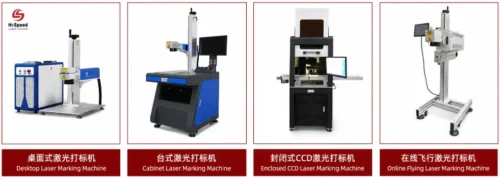
- Standard laser marking machines: Suitable for marking metal logos, text, QR codes, serial numbers, hardware parts, electronic components, and metal gifts. Power options such as 30W, 60W, and 100W can be selected according to the application.
- 3D dynamic focusing laser marking machines: Suitable for curved surfaces, irregular parts, products with height variations, and large-area metal surfaces. They reduce frequent refocusing and improve consistency on curved surfaces.
- 360° rotary laser engraving solutions: Designed for tumblers, sports bottles, cylindrical metal parts, and tubular products, enabling seamless full-wrap graphics, wraparound logos, and continuous marking.
- CCD vision laser marking systems: Suitable for small hardware parts, connectors, electronic components, precision metal parts, and products in multiple specifications. They automatically identify positions and reduce manual alignment.
- On-the-fly laser marking machines: Designed for metal packaging lines, metal component production lines, electronic products, battery components, and industrial parts. They can be equipped with sensors, encoders, conveyors, vision positioning, and data traceability systems.
- Customized automation solutions: Based on product dimensions, materials, marking content, and production cycle time, systems can be configured with rotary axes, motion platforms, multi-station fixtures, CCD vision positioning, 3D dynamic focusing, and automated loading and unloading.
Reflexiones finales
Fiber laser marking is becoming an essential tool in metal manufacturing, industrial traceability, electronic connectors, medical devices, and promotional products. On suitable materials, it delivers clear, stable, permanent, consumable-free marking and engraving that can be integrated into automated systems.
For applications involving stainless steel, aluminum alloys, carbon steel, copper, brass, titanium alloys, metal gifts, industrial parts, electronic components, and medical devices, the right power level, machine structure, and automation configuration can significantly affect product quality and production efficiency.
When the material, surface treatment, depth requirement, or final result is uncertain, sample testing is the key step in confirming the process and equipment configuration.