
With the continuous growth in demand for packaging traceability, gift customization, and non-metal material processing, CO2 lasers are becoming an important choice for more and more manufacturers. Compared with inkjet coding, silk screen printing, labeling, or mechanical engraving, CO2 laser processing is non-contact, requires no ink or plates, and can achieve clear, stable, and easily automated marking, engraving, or cutting effects on suitable materials.
Entering 2026, CO2 laser applications are no longer limited to simple non-metal engraving. They are gradually extending into more specialized production scenarios such as powder-coated cup decoating, wood and leather gift customization, acrylic processing, composite material cutting, and online flying marking.
Why is the demand for CO2 laser marking continuing to grow?
CO2 lasers typically use a 10.6 μm wavelength and have good absorption capabilities for non-metal materials such as paper, cartons, wood, leather, acrylic, rubber, fabric, some plastics, films, and surface coatings. For customers seeking traceability, no consumables, and flexible production, Lasers de CO₂ provide more suitable processing solutions for the following common issues:
- Inkjet coding relies on ink and solvents, resulting in high long-term consumable and maintenance costs.
- Labels are prone to falling off or shifting, which is unfavorable for long-term traceability and high-frequency use scenarios.
- Date codes, batch numbers, QR codes, and barcodes need more stable and clearer presentation.
- Small-batch, multi-style gift customization requires rapid pattern switching, which is not suitable for frequent plate-making.
- Online production lines want to complete marking while products are in motion, reducing line stops and manual operations.
In specific applications, CO2 lasers are not a case of “higher power is always better.” Material, coating, pattern area, product shape, and final effect all influence the most suitable equipment configuration.
What materials and applications are CO2 lasers suitable for?
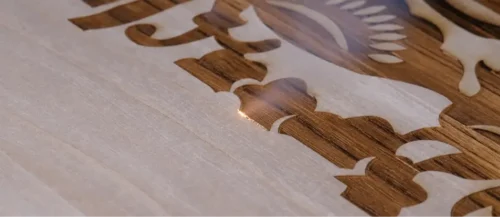
CO2 lasers are most commonly used for marking, engraving, decoating, and cutting of non-metal materials. Different products should undergo sample testing based on actual materials and processing goals.
Typical Application Materials and Scenarios
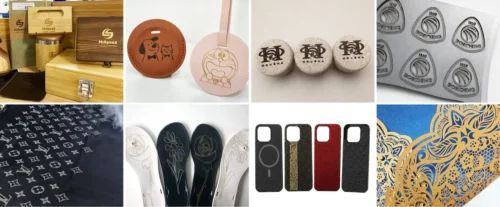
- Packaging: Date codes, batch numbers, QR codes, barcodes, and brand information on cartons, paper bags, labels, some films, and packaging materials.
- Promotional Gifts: Powder-coated stainless steel cups, acrylic medals, wooden gift boxes, leather gifts, and some coated products.
- Non-metal Processing: Engraving and cutting of wood, acrylic, rubber, fabric, leather, paper, and other materials.
- Consumer Goods & Electronic Accessories: Pattern processing and cutting of composite materials, Kevlar phone cases, protective sleeves, and related non-metal components.
- Tip: CO2 lasers are not suitable for all plastics or all surface materials. Some plastics may produce melting, discoloration, or unsatisfactory edge effects. Different films, coatings, and colors can also show significant differences. Therefore, actual sample testing should serve as the basis for final selection.
How to Choose Different Laser Power?
Power selection should consider processing speed, processing area, engraving depth, material type, and continuous production requirements. Below are practical references for common power segments.
Máquina de marcação a laser de CO₂ de 30 W
Suitable for lightweight marking, shallow engraving, and small-batch non-metal customization. For cartons, wood, leather, acrylic, paper labels, and some packaging materials, 30W can usually meet the needs of regular logos, text, and simple pattern processing.
Suitable for: Sample testing, studios, small-batch customization, and basic packaging marking.
60W CO2 Laser Marking Machine
60W offers a better balance between speed, material adaptability, and processing capability. It is suitable for medium-tempo packaging, gift, and non-metal processing scenarios. Compared with 30W, it typically provides higher processing efficiency, more stable batch performance, and greater process margin.
Suitable for: Carton and packaging date coding, medium-batch wood/leather/acrylic processing, and some online flying marking applications.
100W CO2 Laser Marking Machine
100W CO2 laser marking machines are suitable for applications with higher requirements for processing efficiency, engraving area, removal capability, and batch stability. Compared with lower-power configurations, it can provide more sufficient energy for larger patterns, deeper engraving, fast decoating, and continuous processing scenarios.
Suitable for: Powder-coated insulated cups, large-area pattern engraving, high-efficiency promotional gift production, and higher-tempo non-metal processing.
Higher Power and Customized Systems
For thick acrylic, wooden boards, rubber, composite material cutting, or multi-face processing of irregular parts, simply increasing power cannot solve all problems. Motion platforms, fixtures, processing paths, and fume treatment are equally critical to final processing quality and production efficiency.
Major Trends in CO2 Laser Applications in 2026
Market demand is shifting from “single-machine basic engraving” toward higher-efficiency, more flexible solutions that better align with actual production takt times.
- Packaging Online Integration: Date codes, batch numbers, QR codes, and traceability information increasingly need to be completed in real time on conveyor lines.
- Drinkware Customization Upgrade: Powder-coated cups have continuously increasing requirements for decoating speed, edge clarity, and batch stability.
- Flexible Production: Small-batch, multi-style orders drive the use of rapid changeover, rotary axes, moving platforms, and multi-station fixtures.
- Automation Integration: Modules such as sensors, encoders, conveyor belts, visual positioning, and fume purifiers have become part of complete solutions.
- Sample-First Approach: Different colors, coatings, material thicknesses, and surface treatments significantly affect results; the importance of sample testing continues to rise.
What Key Factors Should Be Considered During Selection?
Before determining power, it is recommended to evaluate from four directions: product, content, takt time, and integration requirements:
- Material & Surface: Paper, wood, leather, acrylic, rubber, film, coated materials, or composites.
- Processing Goal: Shallow marking, deep engraving, decoating, cutting, or online inkjet replacement.
- Product Structure: Flat, cylindrical, curved, multi-face, or irregular parts.
- Marking Content: Logos, text, date codes, batch numbers, barcodes, QR codes, or large-area patterns.
- Production Takt: Single-piece customization, medium-batch production, or high-speed continuous conveyor lines.
- Equipment Expansion: Whether rotary axes, X/Y platforms, multi-station fixtures, sensors, encoders, CCD visual positioning, or automated loading/unloading are needed.
For lightweight non-metal marking and small-batch customization, 30W may be sufficient. When efficiency and flexibility need to be balanced, 60W is often more practical. For powder-coated insulated cups, large-area patterns, and high-efficiency production, 100W CO2 usually offers greater advantages. The final configuration should still be based on sample results and actual production takt time.
Hispeed Laser CO2 Laser Solutions
Hispeed Laser can provide CO2 laser solutions ranging from standalone machines to customized integrations for packaging, promotional gifts, non-metal material processing, and automated production lines.
Laser Solutions
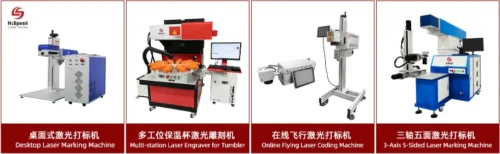
- Desktop CO2 Laser Marking Machine: Suitable for sample testing, small-batch customization, studios, and flexible production environments.
- 100W 3D CO2 Laser Engraving Solution for Tumbler: High-efficiency decoating and engraving for powder-coated stainless steel insulated cups and drinkware.
- CO2 Online Flying Laser Marking Machine: Designed for food, beverage, daily chemicals, pharmaceuticals, and carton packaging. Can be configured with sensors, encoders, conveyor belts, stands, and fume purifiers.
- 3-Axis 5-Sided CO2 Processing System: For Kevlar phone cases, irregular parts, and multi-face non-metal products. Reduces repeated clamping and improves multi-face processing efficiency.
- Customized Automation Solutions: Configured according to product dimensions, materials, and marking content with rotary axes, moving platforms, multi-station fixtures, CCD visual positioning, and automated loading/unloading.
Considerações finais
CO2 laser marking is becoming an important tool in the packaging, promotional gifts, and non-metal material processing industries. It can achieve clear, stable, consumable-free, and automation-friendly marking, engraving, or cutting effects on suitable materials.
For applications involving cartons, wood, leather, acrylic, rubber, fabric, powder-coated cups, some packaging materials, and composites, the right power, machine structure, and automation configuration can significantly impact product quality and production efficiency.
When there is uncertainty regarding materials, coatings, or final effects, sample testing is a key step in confirming the process and equipment configuration.