INDUSTRIAL & OEM JEWELRY LASER GUIDE | HISPEED LASER

Laser Engraving Machine for Jewelry: Complete B2B Buyer’s Guide

Choosing the right laser engraving machine for jewelry can feel overwhelming. Dozens of models exist across fiber, UV, and CO₂ categories. This guide cuts through the noise. It gives factory engineers, shop owners, and distributors a clear path to the right machine.

Request Jewelry Sample Test Solicite uma cotação OEM/ODM
joias gravadas a laser com laser de alta velocidade

Why Laser Engraving Matters for Modern Jewelry Production

The Shift to Laser Technology

Since around 2010, laser engraving has replaced most chemical etching and mechanical methods in the jewelry industry. Jewelers now use focused light to serialize, hallmark, and personalize rings, pendants, and bangles. The results are consistent, fast, and repeatable.

Why Manufacturers Choose Lasers?

Small businesses and mid-size manufacturers now prefer compact laser engravers over traditional tools. Lasers eliminate consumable chemicals. They reduce setup time. They handle curved surfaces without scratching delicate finishes. Laser engraver selection depends on the type of materials to be engraved, so matching the machine to your workflow matters more than raw specs alone.

Built For Industrial Scale 

Demand for custom engravings keeps climbing. Boutiques, pop up kiosks, and online brands all want personalization at scale. Laser de Alta Velocidade is an OEM/ODM industrial supplier, not a retail craft brand. We build fiber, UV, and CO₂ laser machines for manufacturers, system integrators, and distributors worldwide.

MARKET OUTLOOK

$5.86B → $7.83B

Global jewelry customization services reached US$5.86 billion in 2026 and are projected to hit US$7.83 billion by 2030 (~7.5% annual growth).

Main Benefits of Laser Jewelry Engraving:

01 Speed

Galvo laser systems offer high-speed scanning for jewelry engraving. Modern heads move thousands of millimeters per second.

02 Precision

Sub-millimeter to micron-level accuracy enables micro-text, logos, and deep relief work on jewelry pieces.

03 Flexibility

One machine can switch between different metals, shapes, and surface finishes without tool changes.

How Jewelry Laser Engraving Works

A focused laser beam removes or alters surface material through heat or photochemical reaction. The energy vaporizes, ablates, or oxidizes a thin layer. The result is a permanent mark or engraved cavity. Laser engravers can also mark stone-based jewelry materials when using the right wavelength.

3 Core Laser Techniques Explained:

Laser marking

Creates a visible contrast (color change or oxidation) without removing much material. Used for serial codes and logos.

Gravação a laser

Removes material to produce texture or relief. Can be shallow or multi-pass for deeper results.

Deep engraving

Achieves substantial depth for 3D relief, security features, or hallmarks you can feel by touch.

Choosing the Right Laser Wavelengths:

1064 nm Fiber / IR

A 1064nm IR laser is essential for engraving various metals. It handles gold, silver, platinum, titanium, e stainless steel. 1064nm IR lasers can engrave various metals including gold and platinum.

355 nm UV

Cold processing for plastics, resin, enamel, ceramics, e coated surfaces. UV lasers minimize thermal distortion during engraving.

CO₂ (~10.6 μm)

Ideal para wood gift boxes, leather pouches, acrylic displays, e packaging. Poor metal absorption limits it to non-metal accessories.

Concrete examples:

Engraving jewelry like 18K gold wedding bands uses fiber laser at low heat input. 925 silver bracelets with enamel may need UV to preserve coatings. Titanium medical ID tags benefit from MOPA fiber lasers for oxide color effects. Stainless steel charms use fiber for annealing or deep engraving.

Working Process:

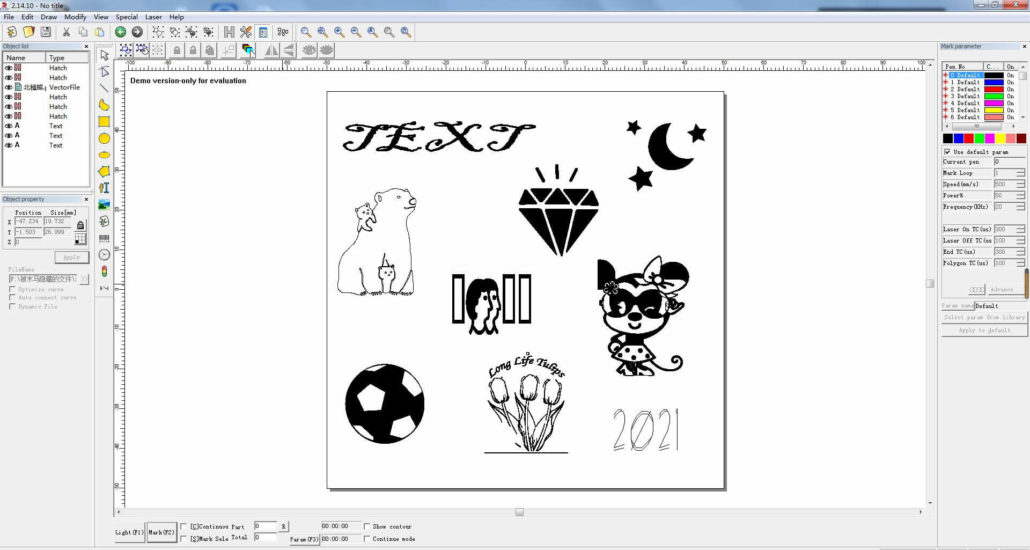
  • Make the gold laser engraving design on your design software Coreldraw.
  • Import the gold laser engraving design to the Hispeed jewelry Laser marking software.
  • Adjust the artwork accordingly.
  • Set up the marking parameters such as speed, frequency, power, hatching.
  • Test and adjust parameters until the marking quality is perfect for you.
Solicitar teste de amostra
máquina de gravação a laser para joias (2)

Types of Laser Engravers in Jewelry Manufacturing

Many jewelry workshops use more than one laser engraver. One handles metals. Another covers plastics, packaging, or coated parts. Here is what each type does:

Fiber laser engravers (1064 nm)

The primary choice for engraving rings, pendants, and watch cases in gold, silver, platinum, palladium, stainless steel, and titanium. Fiber lasers are ideal for marking gold, silver, and titanium. Power ranges from 20 W to 100 W for production work. The WeCreat Lumos features a 3W IR laser for metal engraving at a hobbyist level. The xTool F1 supports engraving on various metals with dual lasers. Jewelry laser engravers must support various metal materials to handle mixed orders. Learn more about what you can do with a fiber laser engraver.

UV laser marking machines (355 nm)

Suited for resin, acrylic inlay, plastic tags, and micro text on watch parts. Power levels range from 3 W to 15 W. UV excels at fine detail on heat-sensitive finishes. Read more about UV laser marking applications.

CO₂ (~10.6 μm) & Full-Line Coverage

Handle wood, leather, acrylic, and packaging that matches fine jewelry branding. Laser engravers can engrave metals like silver and brass, but CO₂ systems need special coatings for metal work. They shine on non-metal accessories.

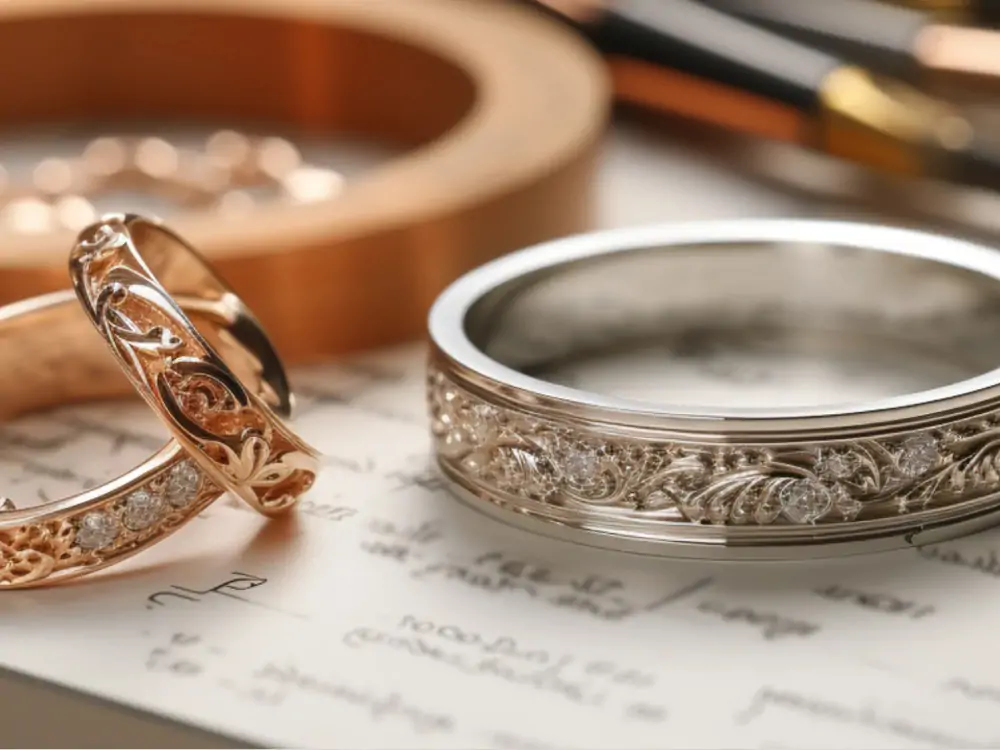
HiSpeed Laser provides all three categories with industrial-grade sources. We offer UV laser machines, fiber systems, and CO₂ units for complete jewelry production coverage.

Contact Our Team

Recommended Fiber Laser Machine for Jewelry Engraving:

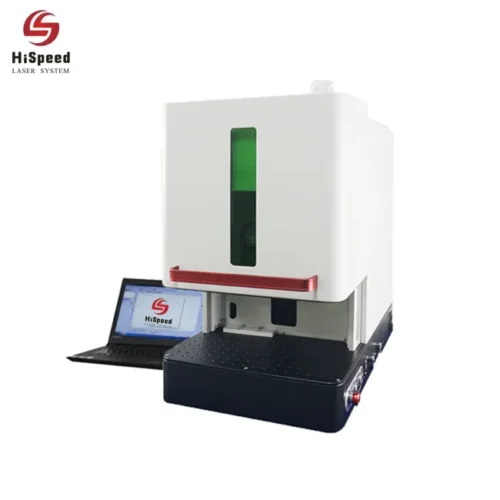
Mini máquina de gravação a laser de fibra óptica com porta deslizante

Built with a 1064 nm fiber laser source (20W / 30W / 50W, up to 100,000-hour module lifespan), ultra-fine <0.01 mm focus spot, ±0.003 mm repeat accuracy, and a ≤150 × 150 mm work area inside a fully enclosed sliding-door cabinet. Designed for safe, high-precision engraving of logos, serial numbers, hallmarks, and fine patterns on gold, silver, platinum, titanium, stainless steel, and plated jewelry in studios, retail counters, and batch workshops.

Solicite um orçamento gratuito

Key Laser Processing Methods for Jewelry

01 Laser Etching / Melting

Laser etching and melting use a focused laser beam to create patterns, textures, or markings on the jewelry surface. During processing, the laser generates localized heat, causing the metal surface to melt or undergo controlled material changes. As the material cools, the treated area forms a visible mark or textured finish.

02 Laser Evaporation

This jewelry laser engraving method generates high heat during the marking process, causing the material to evaporate from the surface. One of the most significant advantages of this method is that it reduces damage to the jewelry surface during the engraving process.

03 Laser Coloring / Annealing

Laser annealing is the same method as standard annealing. With this method, you move the jewelry laser cutting machine over a surface repeatedly, which causes the area to decolorize at a higher laser exposure. This sharp contrast is used to create marks on the material.

04 Laser Bonding

In the jewelry laser cutting machine welding method, another material is used with the original material. The laser helps the external fabric to bond to the base material in the desired shape.

05 Laser Coating and Masking

In this method, the base material has a layer of outer material that you can mark with a laser engraver. This method is suitable for situations where must secure the original material at all costs.

06 Laser Ablation

Laser ablation is a method of engraving the surface coating of the material to be marked. This method provides excellent protection for the original material.

Máquina de gravação a laser para artesanato em metal
Máquina de corte a laser
close-up of a stainless steel bangle bracelet with a crisp Hispeed logo engraved by a laser machine
multiple stainless steel dog tag necklaces with personalized text and patterns laser marked by a high-precision machine
black and blue metal rings featuring precise, fade-resistant laser engravings of the HiSpeed logo
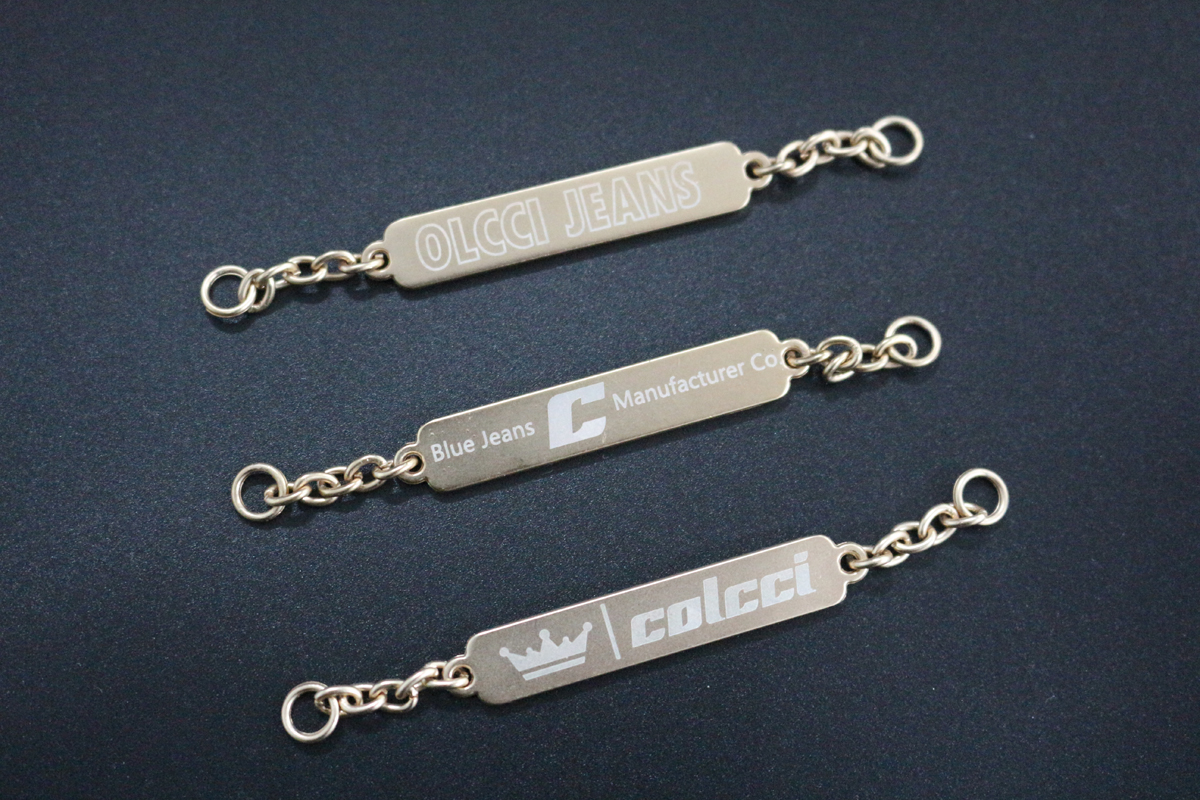
Three custom metal bracelet tags engraved with brand logos and fine text details for commercial jewelry production
four heart-shaped metal pendants in gold, black, blue, and rose gold, laser engraved with the HiSpeed brand logo
black animal-shaped pendant necklaces showcasing fine laser cutting and high-contrast surface engraving

Key Specifications Before You Buy

This section is a practical checklist. Use it to speed up your decision process. Focus beyond power alone.

Especificações What to Look For in Jewelry Production
Power & Wavelength 20–50 W 1064 nm fiber covers most metal jewelry (e.g., 20W fiber Gweike Cloud G2 at entry level), higher wattage suits deep engraving/cutting, and 3–5 W UV handles plastics and coatings.
Engraving Accuracy Luxury serials and micro logos often target 0.001 mm accuracy (e.g., WeCreat Lumos at 8K resolution / 0.00199 mm), while 3D surface reconstruction systems like ESSEGI achieve ±0.05 mm on curved gold and silver.
Work Area & Z-Axis 110 × 110 mm fits rings and pendants; 200 × 200 mm+ suits charm/tag trays; Z-axis clearance must fit tall pieces like watch cases.
Speed & Spot Size Up to 15,000 mm/s (e.g., Gweike Cloud G2 up to 15,000 mm/s, xTool F2 up to 6,000 mm/s, WeCreat Lumos up to 4,000 mm/s) with a small spot size to keep fine detail crisp.
Cooling & Duty Cycle Air cooling fits 20–50 W; above 50 W often uses water cooling, with full-shift stability required for OEM runs.

Choosing the Right Laser Engraver for Fine Jewelry vs Fashion Jewelry

Fine jewelry uses precious metals: 18K or 24K gold, platinum, and high-grade silver. Fashion jewelry relies on brass, plated alloys, stainless steel, and mixed metals. Each category demands a different laser strategy.

Dimensão Fine Jewelry Fashion Jewelry & Accessories
Priorities Precision, depth, certification, minimal heat, repeatability Throughput, budget efficiency, speed, decorative effects, flexibility
Laser & Tooling Deep anti-counterfeit engraving; rotary fixture, autofocus, and curved-surface mapping for custom rings Flexible fixtures; MOPA fiber pulse control for delicate parts and color marking on stainless steel watch backs or displays
Typical Run One-off custom ring where high material value makes scrap costly 1,000-piece silver charm order using batch fixtures and uniform settings

Portability, Benchtop, and Inline Systems: Which Form Factor Fits Your Workflow?

Three form factors serve different scales. Your workflow and site layout determine the best fit. Portable designs are preferred for jewelry engraving at events and kiosks.

Portable / Compact

Suited for mall kiosks, pop up events, and mobile permanent jewelry service. The LaserPecker 4 is portable and controlled via smartphone, with a maximum engraving speed of 2000 mm/s. Portability matters here. Small footprint units are easy to carry and operate. HiSpeed Laser offers a 20W portable fiber laser marking machine for on-the-go work.

Benchtop Enclosed

The workhorse of small factories and repair shops. These enclosed fiber laser machines handle daily engraving of rings, bangles, and watches. They offer better stability, safety, and cooling. Perfect for a dedicated studio or workshop.

Inline / Custom OEM/ODM

Conveyor-fed or robot-integrated. Larger jewelry plants and watch factories use these models for mass production. Higher upfront cost, but they save on labor and deliver consistent throughput.

HiSpeed Laser customizes enclosure size, door style, and fixtures for each customer’s environment.

Essential Features for Efficient Jewelry Laser Engraving

These features translate from marketing buzzwords into real production value. Each one affects your workflow and scrap rate.

Autofocus and motorized Z-axis

Operators switch between ring, pendant, and watch case heights many times per day. Autofocus saves minutes per batch. It reduces focus errors that ruin expensive metal.

Integrated camera or red-light preview

Engraving machines should have an outline preview function. A preview overlay shows exact design placement before firing. This prevents misalignment on tiny objects. It saves scrap on gold and platinum pieces.

Rotary fixtures

Laser machines must have a rotary attachment for circular items. A rotary fixture for rings and bracelets enables 360° engraving, inside-band messages, and bangle patterns. Good fixtures clamp without deforming soft metals.

Curved surface and multi-level engraving

Software tools map logos onto domed signet rings or watch backs. The software must handle distortion correction for non-flat surfaces. This creativity in design drives the custom jewelry market.

Batch fixtures and templates

Custom trays hold 20–100 charms or tags for one-click laser engraving. Flat metal plate fixtures help with deep engraving and cutting jewelry names. These tools turn batch orders into a fun, efficient process.

Safety, Compliance, and Operator Comfort

Jewelry shops must treat laser engravers as industrial machines. This applies even in small studios or pop up booths—protecting your team and your brand reputation.

Laser class and enclosure

Class 1 enclosed laser systems prevent eye damage during operation, whereas open Class 4 heads are dangerous without containment. Enclosed systems with interlocks and safety doors are the standard for any professional site.

Fume extraction

Engraving plated chains and coated charms produces metal oxides and fine particles. Filters with HEPA and activated carbon protect operators, and good extraction also keeps optics clean.

Noise, lighting, and ergonomics

Foot switches free hands for positioning. Adjustable worktables reduce fatigue on long shifts, and clear viewing windows let jewelers inspect details without strain.

Conformidade

Export customers need CE marking, RoHS compliance, or local safety approvals. Laser de Alta Velocidade provides CE, UKCA, and SGS documentation for international projects.

HiSpeed Laser Jewelry Solutions: From Standard Machines to OEM / ODM Projects

HiSpeed Laser is based in Dongguan, China. We hold ISO 9001:2015 certification. Our founder, Yu Lyu, has worked in the laser industry since 2007. We serve global jewelry and watch customers with both standard and custom solutions.

Standard Systems

Our standard fiber laser engraver models for jewelry include compact galvo systems with 20–50 W sources at 1064 nm. These handle engraving rings, pendants, watch cases, and charms in a single setup. Browse our economical máquina de marcação a laser de fibra for entry-level production needs.

We also offer UV, CO₂, e MOPA configurations. Brands that engrave both jewelry and packaging benefit from a multi-machine setup. Our desktop UV laser marking machines handle plastics and coated surfaces with precise, cold processing.

OEM / ODM & Distributors

OEM/ODM options include custom housings, brand colors, software interfaces, and private-label engravers for distributors. We can write custom firmware, design enclosures, and deliver machines under your own brand name.

Global After-Sales

After-sales support covers remote commissioning, spare parts, warranty terms, and on-site service through authorized partners. Our sales and support community spans Europe, North America, and Asia.

8-Step Implementation Checklist

Before comparing laser engravers, define your materials, throughput, engraving types, and budget. A clear scope prevents expensive mistakes.

STEP 01

List primary materials (gold, silver, brass, titanium, aluminum, wood, leather, acrylic).

STEP 02

Define engraving types: marking, deep engraving, or cutting.

STEP 03

Set throughput targets per shift.

STEP 04

Request sample testing on your own jewelry alloys and finishes.

STEP 05

Review machine specs against accuracy and speed needs.

STEP 06

Check factory power, ventilation, and ergonomics.

STEP 07

Confirm safety and compliance (CE, UKCA, SGS, RoHS) requirements for your export market.

STEP 08

Place a trial order before committing to a full production line.

For distributors: if you want to add a jewelry laser engraving line under your own brand, ask about our OEM/ODM programs. We handle everything from design to private-label packaging. You can easily download spec sheets from our site to share with your customers.

Ready to Scale Your Production?

The world of jewelry personalization is growing fast. The right laser machine turns that growth into real revenue. Contact Laser de Alta Velocidade today for technical advice and project planning. Let us help you write your next chapter in amazing craftsmanship.

Talk to Our Engineers