Plastic generally melts at high temperatures. So, marking on plastic using the thermal process is tricky. The engraving often becomes uneven when molten plastic deforms. Regular lasers, such as fiber and CO2 lasers, generate heat to burn or engrave surfaces. It may cause discoloration, burning, or even deformation on delicate materials like plastics. That’s where UV laser marking becomes useful.
This marking method uses UV light with very short wavelengths to mark plastic without generating much heat. You can also call this process “cold marking.” Because of this, UV laser marking on plastic parts ensures no burning and surface damage.
In this article, we will learn more about UV laser marking, especially on plastic parts. You will know its key features and why you should choose it.
What is UV Laser Marking?
UV laser marking, like other marking techniques, creates text, logos, or codes on materials. However, what’s unique is that it uses UV light as the marking medium. UV laser marking is a type of cold laser marking, which means it doesn’t heat the materials much. As a result, it prevents burning, melting, or surface damage.
There are different types of UV laser markers. Some use pulsed UV lasers, which release light in very short bursts. Others use continuous UV lasers for steady marking. They can work with plastics, glass, metals, and even delicate materials.
Many industries prefer laser UV marking over other techniques. In electronics, it is used to mark serial numbers and QR codes on electronic components. The medical industry uses it to create device labeling. For automotive parts, UV laser marking is used for identification, and in consumer goods for logos or decoration.

How UV Laser Marking Works on Plastic Parts
UV laser marking typically alters the color or structure of the plastic. It directs the UV light onto the surface. The plastic surface absorbs it, altering its properties. At the moment, the surface doesn’t absorb any significant heat.
The UV laser marker can create highly precise, detailed marks. It can remove a thin layer of the plastic or change its chemical properties. The process is fast, clean, and repeatable. The final result is sharp, durable marks without damaging the plastic. That’s why UV laser marking is ideal for marking plastic parts.
Why Traditional Laser Marking Causes Burning and Damage on Plastic
Most conventional laser marking processes use fiber lasers and CO2 lasers as their sources. Both types work on plastics and can be used for marking, cutting, and engraving. But plastic’s sensitivity to heat cannot be ignored. If the heat rises too much, the plastic either melts, deforms, or discolors.
When using conventional lasers, there are many technical reasons for causing burns and damage to plastics. The first reason is the laser power. High-power lasers can cut and burn rather than simply mark plastic. Another reason is pulse duration. Longer pulses allow for higher energies and thus cause burning.
The third reason is wavelength. Lasers of this type do not emit the same amount of energy or heat across different types of plastic. This results in some plastics having dark burns while others have uneven texture. Scanning speed is another reason: slower scans mean longer exposure to heat. It causes plastic to melt or become discolored.
Even you can not ignore the plastic’s surface finish and thickness. Thinner plastics tend to burn easily, while darker plastics absorb more energy.
For these reasons, traditional laser engraving often results in poor quality, including roughness, unevenness, or burning. However, with UV laser engraving, extremely short wavelengths and little heat are used. Hence, quality engraving is achieved.
Key Features of UV Laser Marking Machine
UV laser marking machines are designed to mark delicate materials, like plastics, safely and accurately. They typically combine precision, speed, and reliability. As a result, it can ensure the safety and quality of delicate materials.
High Precision & Fine Details
UV laser marker machines offer very high precision. They can mark lines as small as 10-20microns with tight tolerances. Because of this, UV laser marking can create high-resolution marks. It can create high contrast logos, QR codes, and serial numbers on small parts. Compared to other marking methods, UV laser marking produces sharper, cleaner marks.
Cold Marking Process
UV laser marking works through a cold process. Its output laser power is not enough for cutting or engraving tasks. It is only designed for marking purposes. What it does is enable chemical changes or the removal of a thin layer.
On the other hand, fiber and CO2 lasers create high localized heat, which may cause burning or melting of plastics.
Other cold marking methods, such as ink or pad printing, could smudge or fade. On the contrary, UV laser marking creates permanent marks.
Works on Delicate Materials
UV laser marking is a safe way to mark on delicate materials. Since UV laser marking produces very little heat, even fragile or thin materials remain intact. You can work on plastics, acrylic, medical-grade polymers, and heat-sensitive components. As a result, it is ideal for use on medical devices, electronics, auto parts, and consumer goods.
Clean & Smooth Process
The UV laser marking process is relatively clean. It doesn’t produce smoke, debris, or any residue like thermal methods. As a result, you don’t need to do any extra cleaning work.
Fiber or CO2 lasers often produce smoke, which requires safe ventilation methods. Therefore, UV laser marking ensures smooth and precise engraving. Thus, it can save time and maintain a polished surface.
Fast & Efficient Performance
UV laser marking is much faster than traditional marking methods. If you consider pad printing, hot stamping, or etching, they are slower than UV laser marking. It can mark hundreds of times per minute. As a result, UV laser printing is suitable for high-volume production.
High Stability and Control
UV laser marking machines offer excellent control over various laser parameters. For example, you can control laser power, pulse duration, or speed. So, you can customize the settings based on your project needs or material types.
Why Choose UV Laser Marker for Plastic Parts
There are several reasons to choose a UV laser marker for plastic parts. In addition to the benefits mentioned above, there are three main reasons for this. First, it ensures no burn or damage marks on plastics. Second, it reduces material waste and, finally, delivers long-lasting results.
No Burning, No Damage, Clean EngravingThe
The UV laser marker machine uses ultraviolet light with a very short wavelength. It typically creates almost no heat. This “cold marking” process ensures that delicate plastic parts remain intact and the marks are not deformed.
If you see how fiber and CO2 lasers work, you’ll see that they generate rapid heating that damages the plastic surface. UV laser marking has no risk of melting, discoloration, or surface deformation. The engraving is precise, sharp, and visually clean. You can ensure high-quality products and ensure clear texts, logos, or codes without any damage.

Less Material Wastes
Since UV laser marking avoids burning and surface damage, there is far less material waste. With it, you can reduce the number of defective or damaged parts and production losses. You can control the entire process, and it’s highly repeatable. So, you can mark large quantities of plastic parts efficiently.
This way, you can not only save raw materials but also lower production costs. Overall, it improves manufacturing efficiency.
Long-Lasting Results
Marks created by UV laser are durable and very resistant to wear, fading, or peeling. The laser can alter the surface or chemical properties of the plastic. It makes the engraving stable over time. As a result, the serial numbers, QR codes, logos, or text remain readable throughout the product’s life.
Difference Between UV, Fiber, and CO2 Lasers
Different types of plastics behave differently under different lasers. With plastic, heat is the primary concern, and three laser parameters typically govern it. UV laser printing works at very low temperatures. On the other hand, Faser und CO2-Laser often melt plastic or create deformed marks.
| Parameter | UV-Laser | Faserlaser | CO₂-Laser |
| Wellenlänge | 355nm | 1064nm | 10.600 nm |
| Heat Generation | Sehr niedrig | Hoch | Hoch |
| Tendency to Burn Plastic | Sehr niedrig | Moderate to High | Hoch |
| Suitable for Delicate Plastics | Excellent | Limited | Limited |
| Marking Precision | Sehr hoch | Hoch | Mäßig |
| Surface Damage | Minimal | Possible | Likely |
| Ideal Applications | Electronics, medical, automotive, consumer goods | Metals and some plastics | Wood, acrylic, and general plastics |
As you can see from the table, the UV laser produces clean marks on plastics without damage. However, not all plastics will give you the same output. You must carefully assess the type of plastics and the laser configuration settings. Even some plastics work better with fiber- and CO2-lasers.
Zusammenfassung
While all three laser types can be used for plastic marking, their applicability differs significantly. When we talk about plastic, it is vital to remember that heat plays the main role. Both fiber and CO2 lasers generate significant heat. It causes distorted marks to appear on plastic. Here comes the use of a UV laser, which eliminates the problem.
The UV laser emits short-wavelength light and produces little heat. Consequently, it prevents burning, melting, or any other damage to plastic.
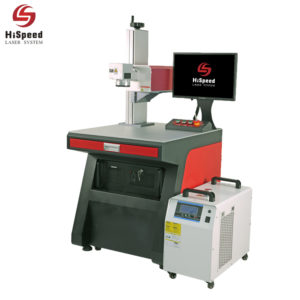
HiSpeed Laser specializes in producing Maschinen for UV laser marking. There are many variants depending on the scope of usage and its purpose. You can even customize the machine to fit your requirements.
Feel free to Kontakt our customer support department if you have any questions or would like to place an order.