
In industrial manufacturing, billions of trillions of parts are made. Still, manufacturers can track them and identify details. How? Traceability is one of the most important steps in manufacturing. Consequently, barcode engraving plays a crucial role here.
The tricky part is how you engrave the barcode. You might have many different materials, some with coatings and some without. People used stickers in the past, but those didn’t last very long. People couldn’t be sure that the marks would last even with the strongest glue. Barcodes wear down over time due to heat, moisture, chemicals, and friction. This is where barcode laser etching comes in, offering practical solutions.
Still, not all laser engravers can offer you similar results. The right type depends on the materials you are working with and your project needs. Laser engravers come in many types, and you should know how to choose the right one. This article explains what you need to know.
Understanding Industrial Traceability & the Use of Barcodes
Industrial traceability means tracking a product from the beginning through delivery to the customer. Typically, it begins with etching on the material surface. Each part has a unique ID that contains the necessary information. It includes the batch number, date, machine, and often the operator. A barcode carries this ID on the part.
Traceability is a broad process. It includes various types of product-related data. Identifying the product is one part of it. It can include information such as batch number, part no., and production or expiry date. It may also include country, plant code, URL, or ID.
Product traceability protects quality and safety. If you detect a defect, you can quickly identify the cause. It helps fix the issues quickly. It also lets you limit a recall to the affected batch. It protects your brand and saves money. Most industries follow strict protocols for this work. Automotive, medical, and aerospace firms must show the origins of every component.
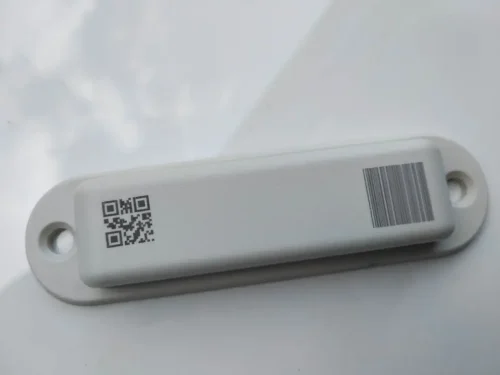
Barcodes play a significant role in every field. They are small and fast to scan. A scanner can easily read the code in a split second. You can create these codes using multiple methods, such as dot peening, chemical etching, and others. Lasers are the most popular option. They last the lifetime of a product.
What Makes a Barcode Reliable for Industrial Traceability
A reliable mark is easy to read and stays high-contrast every time. It must stand out clearly from the part’s surface. For this reason, it should be sharp. Each cell must be the right size, with even spacing. Maintaining proper precision helps keep barcodes consistent. Scanners can read these codes without errors.
The code must also last through the product’s lifespan. Many factory parts face harsh weather, heat, chemicals, oils, and rubbing. Laser marking easily withstands these conditions. Marks do not fade or peel off over time. Rather, it provides lifetime durability throughout the product’s lifespan.
Why Laser Marking is Better for Industrial Barcode Engraving
Laser barcode engraving is the most popular choice for industrial products. It creates a permanent, durable mark without damaging the surface. The laser beam alters only the part’s surface. Here is why laser marking is better for industrial barcode engraving.
- The laser-engraved barcodes can easily withstand chemicals, heat, friction, and other environmental conditions.
- Unlike traditional methods, laser marking does not require inks or stickers to apply barcode marks. These barcode engravings will not fade or peel off over time.
- Lasers provide consistent results on every product and easily engrave machine-readable codes. Each mark’s clean, sharp, dark line appears clearly on a lighter background. This practice helps to ensure high optical readability.
- In addition, the laser system is incredibly fast and offers superior repeatability.
- The laser does not physically contact the material, which significantly reduces material waste and downtime. The laser marking machine renders every barcode uniformly. As a result, it keeps the production line running with continuous peak output.
- Laser marking works well on a wide range of materials, such as metals, wood, acrylic, leather, fabric, plastic, ceramics, and more.
Overall, laser marking is a versatile option. Different lasers suit different applications. Fiber lasers suit metal marking, while CO2 lasers are an ideal choice for non-metals. UV lasers are perfect for plastic marking. Choosing the right one is the top priority. Select one based on your material preferences.
How to Choose a Barcode Laser Engraving Machine for Industrial Traceability
Choosing the right barcode laser engraving machine is the most vital step. It affects every code you mark and the quality of your barcodes. However, selecting a low-quality machine leads to poor marks and scan failures. On the other hand, a high-quality barcode laser marking machine ensures clean, sharp, long-lasting codes. In this case, several factors matter. These include material, code quality, speed, and cost.
Consider the Working Material
The process starts with the material you want to mark. Different laser types support different materials. Fiber lasers are an ideal choice for metals like aluminum, steel, copper, brass, and others. CO2 lasers suit non-metals such as wood, acrylic, ceramics, leather, and so on. UV lasers work well for heat-sensitive plastics and glass. Therefore, always test on your real samples to make sure it works.
Barcode Size, Contrast Level & Scanning Quality
Consider the code size you need for your project. For small codes, you need a precise, fine beam. For this, ask the manufacturers for the smallest cell size the machine can mark. The laser marking barcode machine must handle the tiny data matrix codes with extreme precision. Check the contrast on your material and scan with your own reader. Moreover, choose a laser barcode marking machine that supports code grading and verification.
Marking Durability
A barcode should last throughout the product lifecycle. Consider the harsh conditions it may go through, such as heat, oil, friction, chemicals, or other wear. Engraving works deeply, so it suits engine and aerospace parts. Annealing results in a smooth surface suitable for medical equipment. In contrast, ablation strips coatings from anodized parts, and laser foaming is ideal for marking plastics. Match your marking type to your requirements.
Production Speed & Precision
Match your machine to your production line speed and precision needs. Complete each barcode engraving within the cycle time. You can ask for a real marking time for your own codes. The more power you use, the faster you can mark. But precision matters too. So choose the machine that offers the best balance of performance.
Automation & Production Line
Think about how the machine will fit into your line. Laser Markers come in both automated and manual options. Automated options connect to conveyors, PLCs, or robots. They are fast, steady, and suit heavy-duty applications. Manual machines, by contrast, are ideal for small-batch orders. Choose a system that best fits your volume, budget, and workflow.
Cost & Maintenance
Barcode engraving laser machines may seem expensive at first, but they become profitable in the long run. Unlike traditional methods, laser barcode engraving has lower running costs and works much faster. Maintenance costs are also comparatively lower. Before buying, check the warranty or guarantee. Verify their customer service feedback. Good support and a strong warranty usually mean a reliable brand.
Best Laser Barcode Engraving Machines for Industrial Traceability
Barcodes must be clear, sharp, and easy to scan. So, you need to choose the right machine to meet the exact goal. Some jobs may require portable tools, while others may need an automated line. Others need CO2 lasers. Here are the three best options from Hispeed Laser. Each serves a particular purpose for industrial traceability.
Máquina de marcação a laser de fibra
Fiber laser marking machines have both handheld and automated types. The handheld laser marking machine is portable, compact, and easy to use. It can mark any part of large machinery and components. It comes in 20W, 30W, and 50W flexible systems. A wheel controls the entire cabinet so that you can move it according to your production lines. It requires no consumables and needs almost no maintenance.

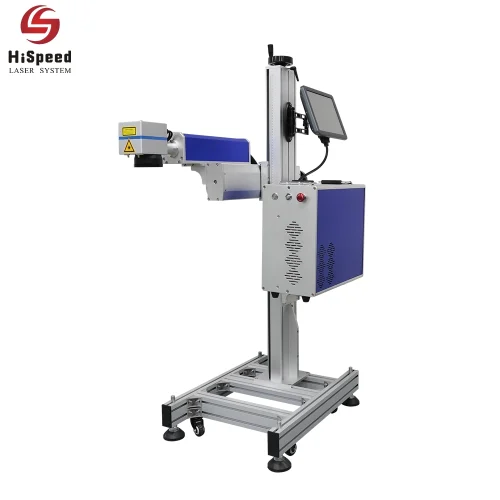
O máquina de marcação a laser “fly” is ideal for mass production. You can automate it or connect it to a PLC or conveyor system. Its Raycus laser source is expected to last 100,000 hours. It also offers speeds up to 7000 mm/s. It comes in 20W, 30W, and 50W models and marks auto parts, bearings, and packaging smoothly.
CO2 Laser Marking
The Hispeed LS CO2 laser marking machine easily engraves and cuts non-metals. It offers a wide range of functions suitable for marking various materials. It can easily handle wood, acrylic, MDF, leather, fabric, and plastic. This machine has a water-cooling system that keeps it stable during production. A DSP controller lets you run production from a USB drive without a PC.

Resumo
Picking the right way to engrave a barcode is always very important. The right machine produces clear, long-lasting, accurate marks. Before you choose, consider the material, barcode size, and the quality you need.
Fiber laser marking machines are typically suitable for marking metals and certain plastics. CO2 lasers, on the other hand, work well for non-metals. Both offer benefits for different applications.
When choosing the right machine, also consider maintenance and cost. For low-volume production, manual marking might be suitable. For mass production, automation is preferred. For further inquiry, feel free to contato HantenCNC customer support. Our team can help you find a solution that fits your marking needs.