
During manufacturing, parts can get dirty and contaminated. These contaminants or stains get sticky and difficult to remove. That’s where the laser cleaning and sandblasting methods come into play. They help remove the rust, paint spots, and different coatings. However, these methods differ, sparking debate over laser cleaning vs sandblasting.
Interestingly, both methods are actively used across different industries. However, their effectiveness and efficiency are what set them apart. The cleaning method you should use depends on your needs and budget. In this article, I will discuss the differences between laser cleaning and sandblasting. So, let’s get started.
What is Laser Cleaning?
As the name suggests, laser cleaning relies on high-energy laser beams. This method uses a laser cleaning machine. Due to this, it is a non-contact process in which a high-energy laser beam is directed onto the contaminants. These can be rust, paint spots, any coating residue, and so on. The contaminants absorb the energy coming from the laser beam, which is very important.

This higher energy absorption leads to the vaporization of these contaminants. In some cases, the laser energy does not vaporize the contaminants. So they simply break down contaminants into small particles that can be cleaned easily. You might be wondering how the base material remains unaffected when a laser beam is applied to it.
Actually, the base material does not absorb the energy of laser beams. This energy reflects from the surface of base materials. This way, the base material remains safe and unaffected during this cleaning process. This laser-based cleaning method can work on a wide range of contaminants. This makes this process very versatile, suitable for rust, paint, oxide layers, and more.
What is Sandblasting?
Sandblasting is another popular cleaning method used for surface preparation. This method involves bombarding abrasive particles onto the contaminated materials. These abrasive particles, such as sand or glass beads, strike the contaminants with force. This strike breaks down contaminants and helps clean those sticky spots.
Sandblasting is also commonly known as abrasive blasting. Why? That’s because it uses abrasive particles for cleaning the base material. In this method, a dedicated blasting machine is used. These machines deliver high-pressure compressed air and propel it towards the contaminated material.
It is worth noting that this air is propelled at high pressure to break down contaminants. Just like laser cleaning, this method also works with a wide range of impurities and contaminants. However, this method is generally more affordable than laser cleaning. That’s the major reason behind the popularity of the sandblasting method.
Which is better: laser cleaning or Sandblasting?
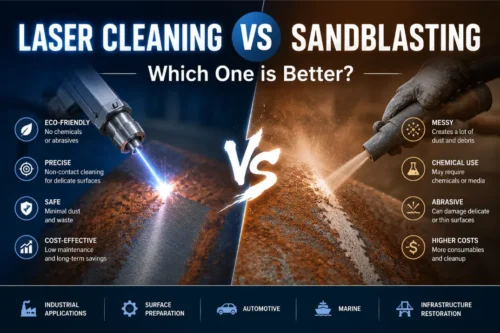
As I said above, laser cleaning and sandblasting differ in many ways. Without understanding them, it can be difficult to establish which is better. In the section below, I will explore all the key differences between laser cleaning and sandblasting. This will help you know which is the best option for your custom project.
1- Method & Mechanism
The laser cleaning method uses a high-energy laser beam. On the other hand, sandblasting uses abrasive particles, such as sand or glass beads. These particles hit the contaminants with high pressure and break them. Laser cleaning is generally considered superior due to its contactless operations. However, this method may not be ideal for removing a thicker coating. In contrast, sandblasting can easily remove even thicker, very sticky coatings.
2- Precision & Surface Damage
Laser cleaning is a better option for precision and surface damage. This method bombards contaminants with laser beams. This energy is absorbed only by contaminants, while the base material reflects it. This ensures better precision and no surface damage to the base material. Sandblasting involves bombarding the surface of base materials with small particles. You might notice surface roughness due to sand particles hitting it with high force. You should use laser cleaning for sensitive materials where precision is important.
3- Waste & Speed (Efficiency)
Laser cleaning is known for its high standard of cleanliness. It produces no waste and removes the rust, paint, and other coatings efficiently. Laser beams hit the contaminants with precision, ensuring no waste. However, the speed of laser cleaning is a bit compromised, which is a drawback. Sandblasting bombards base materials with sand particles, resulting in higher material waste. However, the cleaning method is very fast, making it ideal for quick surface preparation.
4- Material & Size Compatibility
Laser cleaning is a versatile option compatible with a wide range of materials. These include various metals, plastics, and more. This method can work equally well on both soft and hard materials. However, when it comes to size, laser cleaning is best suited for small to medium-sized materials. On the other hand, sandblasting can clean large materials with ease. However, this method is only suitable for harder materials. When used on soft materials, sandblasting can result in greater surface damage (material erosion). You’ll also notice surface roughness due to the bombardment of particles on materials.
5- Safety & Surface Finish
Laser cleaning is best for safety. Why? This cleaning method vaporizes the contaminants without producing dust or airborne particles. There is no risk of inhaling dust when working with laser cleaning. Additionally, it does not affect the material’s surface. Conversely, sandblasting produces dust when contaminants are removed by bombarding with sand particles. These dust particles, if inhaled, can cause respiratory issues. Additionally, they make the material’s surface look rough, making it appear less refined.
6- Cost & Consumables
Both laser cleaning and sandblasting differ in terms of their cost and consumable requirements. Laser cleaning is generally expensive, which is a drawback. The reason is that machines used in laser cleaning are expensive. However, these machines do not require additional consumables for their operations.
This reduces their long-term costs. On the other hand, sandblasting is cheaper with a lower upfront cost. This makes this method suitable for someone with a tight budget. However, blasting machines require consumables for their operation, such as sand or glass beads. These consumable requirements make the sandblasting method more costly in the long run. So whether you want high upfront cost or low ongoing cost – the choice is yours.
Perguntas frequentes
What are the disadvantages of laser cleaning?
First, laser cleaning is expensive, which can be a constraint for many customers. Additionally, this method may not be the best choice for larger materials. Despite these drawbacks, laser cleaning is widely used due to its many advantages.
Is laser cleaning cheaper than sandblasting?
No. Laser cleaning is generally more expensive than sandblasting. This is primarily due to the higher upfront cost of laser cleaning machines. However, these machines do not require consumables. This has significant benefits, as it reduces their ongoing costs compared to sandblasting.
Does laser cleaning remove rust?
Yes. Laser cleaning is an excellent way to remove rust and corrosion. In fact, this method can remove very thick rust as well. Apart from rust, you can also use it to remove oxide layers, paint coatings, and so on.
Conclusão
In short, laser cleaning and sandblasting are excellent methods. These cleaning methods are widespread across different industries. However, you can be confused when it comes to choosing between any one of these two. I consider laser cleaning a better option due to its superior precision, efficiency, minimal waste, and so on.
On the other hand, if you have a tight budget, you can choose sandblasting. Remember, there are drawbacks to this method that you should be aware of. These include its incompatibility with soft materials, material waste, reduced precision, and so on. Hopefully, this guide will help you understand which of these two cleaning methods is the best.