
In drinkware factories, customization has become very popular. Companies now print names, logos, and designs on bottles, tumblers, and mugs to attract customers. However, most of these drinkware items come with a powder-coated surface. This surface gives them color, shine, and protection. But at the same time, powder coating is a huge challenge when you want to engrave marks on those bottles. That’s why powder coating removal for engraving becomes crucial. For this removal, industries use several methods, among which CO2 is very popular. However, for your convenience, I will explain all the powder coating removal methods in this guide. So let’s get started.
Why Is Powder Coating Removal Needed for Engraving?
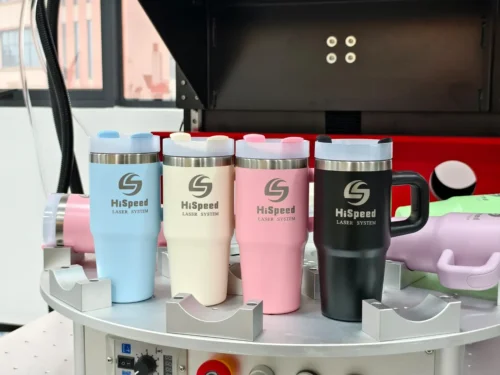
Engraving has become the most popular method for customizing bottles. However, the drinkware comes with a powder-coated surface. No doubt this coating protects and gives shine to the bottle. But for engraving, it must be removed. Why? Here are some reasons.
- To make the Design Visible: The powder coating is usually colored, such as black, blue, or red. If you try to engrave directly on such a surface, the design may not stand out. However, when this coating is removed, the shiny underlying surface comes to light. This surface will now make the design visible and smooth.
- To create a Strong Contrast: The second reason for removing the powder coating is to create a strong contrast. Remember, engraving is not only about making designs. Instead, it also helps you create visual contrast. Suppose you want to engrave the black bottle. So when you remove the coating, it reveals a shiny silver layer. Now, this silver-and-black contrast looks more attractive.
- To Improve Engraving Accuracy: Powder coating can sometimes block or weaken the engraving process. As a result, the final design will be uneven and unclear. So when you remove the upper powder coating, the engraving becomes more precise. The laser machine will work and mark the surface without hindrance. This creates a clear, even, and detailed design.
- To Ensure Better Product Appearance: In the drinking industry, appearance matters a lot. It actually reflects the brands’ reputations. Removing the powder coating helps brands create a strong visual identity by engraving, which lasts longer.
How Powder Coating is Removed for Laser Engraving: Some Common Methods
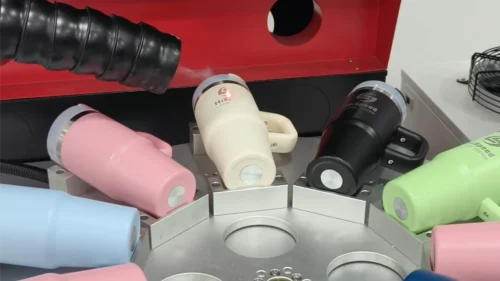
Now you understand why powder coating removal is crucial for engraving the drinkware, right? Now I know that this coating is not always removed in the same way. Several methods help factories remove the powder coating. So let’s dive in and explore those methods that will help you.
1- CO2 Laser Method
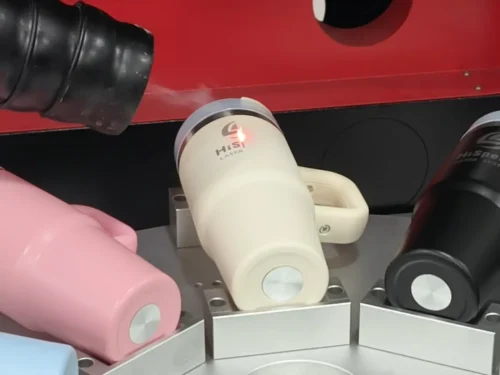
The first, most popular, precise, and widely used method for removing powder coating from drinkware is CO2 laser removal. In this method, CO2 laser machines are used to remove the coating. The laser machine produces a very thin, precise beam of intense light. This beam hits the required surface, such as a tumbler or mug, and removes the coating. How?
Actually, the beam contains a lot of heat energy. This heat quickly melts the upper layer without touching the underlying metal or glass. That’s why this totally non-contact process saves the actual material from damage. Another thing that makes the CO2 laser the best choice for removing powder coating is its precision.
Basically, laser machines are often automated. They are CNC-controlled. It means the laser can remove coating in very small areas with great detail. Also, this very fast process, which works in seconds, proves handy for large production where time matters a lot.
2- Mechanical Methods
Mechanical methods are one traditional way to remove the powder coating layer before engraving. No advanced machines are used in these methods. Instead, workers remove the coating from drinkware by physically rubbing or scraping. For this, you can use tools such as sandpaper, grinding wheels, or abrasive blasting materials.
But how do these methods work? For example, when you use sandpaper or a grinding wheel, you have to rub it against the powder layer gently. This rubbing will slowly remove the coating. However, in the blasting mechanical method, small beads are shot at high speed onto the surface of the drinkware. These beads remove the coating through impact.
As there is no need for advanced machines, mechanical methods are often cost-effective. But remember, with these methods, the risk of actual material damage increases. Since there is no precision, it might hit the drinkware’s surface, resulting in material waste. However, mechanical methods for removing the powder coating are still used in small factories and workshops.
3- Chemical Removal Methods
Another method for removing powder coating for engraving is using chemicals. In these methods, special chemicals, liquids, and solutions are used. For the drinkware you want to remove the powder coating from, pour the chemical directly onto its surface. The chemical will react with the powder layer, weakening its bond to the drinkware.
Once it’s done, the layer will slowly peel off. Now you can remove this layer by washing with water. However, sometimes you have to dip the drinkware into the chemical bath for some time. Why? Because some coating powders are very sticky and hard, they do not come out quickly.
So basically, chemical methods are also effective in removing every powder coating. However, safety is of utmost importance there. A small splash of the chemical can cause serious hazards. Also, be careful that no chemical residue remains in the drinkware.
4- Heat-Based Methods
Lastly, heat-based methods are also used to remove powder coating for engraving. You use high heat to burn or break down the coating layer on drinkware. First, you have to place that drinkware into the furnace. Then the temperature is gradually raised until the powder coating begins to leave the drinkware’s surface. This heat actually weakens the layer, making it loose.
Once you notice the layer is starting to peel off, keep the temperature stable. Now the entire coating is removed to let the bottle cool. After that, clean and rinse the drinkware with water. But remember, the heat-based method does not offer very fine control. That’s why it is difficult to remove the coating only from specific design areas. Also, high heat can sometimes damage the interior surface, making the drinkware unsuitable for drinking.
CO2 Laser vs Other Methods: Quick Comparison
As you can see, there are several methods for removing the powder layer from drinkware before engraving. Also, it is clear that all those methods work differently and give different results in terms of quality and speed. That’s why it is crucial to choose the right one for your project. To make this decision easier for you, here is a comparison table.
| Method | How It Works | Accuracy | Velocidade | Best Use |
| Laser de CO₂ | Uses laser to vaporize coating | Very High | Very Fast | Drinkware engraving, logos |
| Mechanical | Scrapes coating physically | Baixo | Médio | Basic cleaning |
| Chemical | Dissolves coating with chemicals | Médio | Lento | Small or complex parts |
| Heat-Based | Burns coating using heat | Baixo | Rápido | Bulk removal only |
Why is the CO2 Laser Best for Powder Coating Removal in Drinkware Factories?
Laser technology is popular due to its speed, precision, and reliability. So when factories need to engrave, they choose a CO2 laser for removing powder coating. But that’s not all. Here, I will discuss the reasons why the Laser System for Powder-Coated Tumblers is the best.
- High Precision for Detailed Designs: The first thing that makes the CO2 laser best for coating removal is its precision. As I said above, the beam is extremely focused. So it removes the powder coating only from the exact area where the design is needed. The rest of the drinkware remains as it is.
- Fast Speed for Mass Production: Secondly, the CO2 laser removal is very fast. The reason lies in its automation. The CNC-based CO2 laser marking machine quickly removes the powder coating. This helps factories complete large orders more quickly, saving time and reducing costs.
- Clean & Professional Results: CO2 lasers remove powder coating with very precise control. After powder removal, the edges of the design look sharp. There are no rough surfaces, scratches, or other damage. As a result, the final product is smooth, which is most crucial for brand identification.
- No Physical Contact with the Product: In mechanical coating-removal methods, the tool does not actually touch the drinkware. This can sometimes damage the product, resulting in material waste. However, the CO2 laser is a totally non-contact process. It removes the coating from a distance. So there is no risk of scratches, dents, or deformation to the drinkware.
- Easy Automation & Integration: Lastly, the CO2 laser’s automation is very easy. These machines can be connected to the automated systems to ensure precision. Also, for curved surfaces like bottles, the CO2 laser cutter can be connected to a rotary attachment. This helps the drinkware factories achieve automation and handle all drinkware surfaces.
Perguntas frequentes
Are CO2 lasers expensive for powder coating removal?
Yes, CO2 lasers can be expensive at the beginning, especially for factory-level machines. However, they work fast, give clean results, and reduce manual work. All this helps save money in the long run, which makes it worth it.
Can CO2 lasers remove all types of coatings?
No, CO2 lasers cannot remove all types of coatings equally well. They work best on powder coatings and other non-metal layers. However, they may not be very effective on some hard or reflective coatings.
What happens if the coating is not removed properly?
If the coating is not removed properly, the engraving will not work properly either. It will look faded, rough, and unclear. This can reduce the overall quality of the product and make it look less professional.
Conclusão
Powder coating removal is the most critical step during the engraving of drinkware. Suppose this coating remains during engraving; the design would be rougher and less precise. However, you might wonder how this coating is actually removed in factories. To help you understand the procedure, I have discussed some methods in this guide.
For example, you can remove that coating using abrasives, chemical heat, and lasers. Among those, using CO2 lasers is the best and most efficient method. This is because of their accuracy, their automation speed, and their lack of damage. This helps the drinkware factories speed up the engraving process and meet the deadlines. However, if you are working on a small scale, you can choose the method that meets your project requirements.