
As the markets for customized apparel, sportswear, footwear and bags, brand labels, and personalized consumer products continue to grow, heat transfer vinyl (HTV) is becoming an increasingly important material category in the garment accessories industry.
At first glance, heat transfer vinyl may seem to be simply a decorative material used on apparel, footwear, hats, and bags. From a production perspective, however, it involves multiple factors, including material structure, design accuracy, edge quality, transfer adhesion, and batch efficiency. As multi-style, small-batch, and fast-turnaround orders become the norm, traditional die cutting and mechanical cutting methods are facing higher demands for both efficiency and flexibility.
For this reason, laser engraving and cutting are becoming important processes in heat transfer vinyl production. Its value extends far beyond merely cutting graphics; it enables manufacturers to adopt flexible, stable, digitally-oriented workflows for complex materials, diverse designs and variable-volume orders.
Why Is Heat Transfer Vinyl Processing Shifting Toward Laser Technology?
Heat transfer vinyl is widely used for garment accessories, labels, brand logos, sports numbers, footwear and bag decoration, and personalized graphics. The material is transferred from a carrier film onto fabric or other substrates under heat and pressure, so processing quality directly affects the appearance, feel, and durability of the finished product.
In the past, some standard designs could be produced using dies, die-cutting systems, or other mechanical methods. As market demand changes, however, customers are placing much higher expectations on design complexity, delivery speed, and customization flexibility.
For garment accessory manufacturers and heat transfer processors, more orders now involve rapid switching among multiple colors, sizes, logos, and designs rather than long runs of a single pattern. When conventional methods require new dies, die changes, or manual edge trimming, overall production efficiency declines.
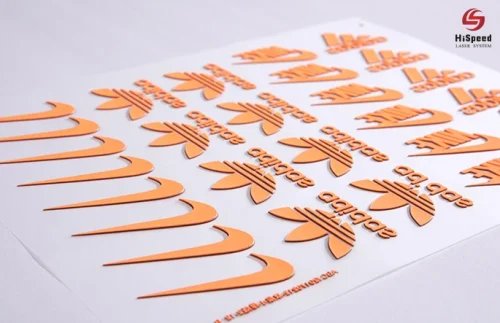
Laser engraving and cutting do not rely on physical tools, nor do they require a separate die for every design. By simply changing the digital design file, manufacturers can process different graphics quickly. This makes laser processing particularly well suited to the evolving needs of apparel customization and branded accessory production.
The Role of Laser Engraving and Cutting in Heat Transfer Vinyl Processing
In heat transfer vinyl production, lasers mainly perform two core tasks.
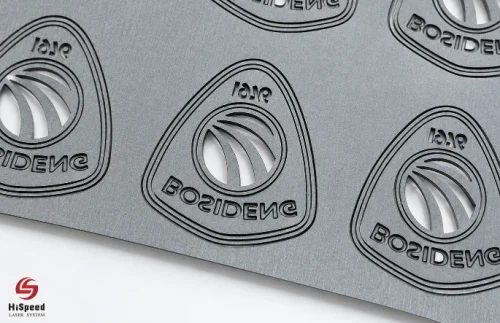
The first is design engraving. A laser can create logos, textures, text, or decorative effects on the material surface, making it suitable for brand identification, apparel decoration, special visual effects, and personalized graphics.
The second is contour cutting. The laser follows the design file to cut the outline of the graphic, allowing the excess material to be removed cleanly before the subsequent heat transfer process.
The coordination between these two processes directly affects finished-product yield. For sports numbers, brand logos, reflective graphics, and multilayer heat transfer films, manufacturers need more than accurate designs: they also need clean cut edges, a soft hand feel, and stable adhesion after heat pressing. These are key advantages of laser processing compared with conventional mechanical methods.
Why Is CO2 Laser Processing Better Suited to Heat Transfer Vinyl?
Most heat transfer vinyl materials are non-metallic films and respond well to CO2 laser processing. A CO2 laser removes and cuts material through a controlled thermal effect. With a wavelength of 10.6 μm, CO2 lasers are well suited to TPU, PU, flocked films, and many reflective heat transfer vinyl materials, enabling both surface removal and contour cutting.
Compared with mechanical cutting, CO2 laser processing offers several clear advantages:
- Better for complex designs. Fine lines, hollow structures, curved edges, and frequently changing logos can be controlled directly from digital files without being limited by tool geometry.
- Less contact-induced deformation. Heat transfer vinyl is usually thin, and some materials are soft or elastic. Mechanical pressure can cause shifting, stretching, or edge deformation, while non-contact laser processing helps reduce these problems.
- More suitable for flexible production. For multi-style and small-batch orders, laser systems can switch designs quickly, reducing die-making and machine setup time.
However, higher laser power does not automatically mean better results. Material thickness, adhesive-layer structure, color, surface coating, and downstream transfer requirements all affect parameter selection. A stable process requires the right balance among speed, power, focus, toolpath, and number of passes.
Large Working Areas and Dynamic Focusing Improve Batch-Processing Stability
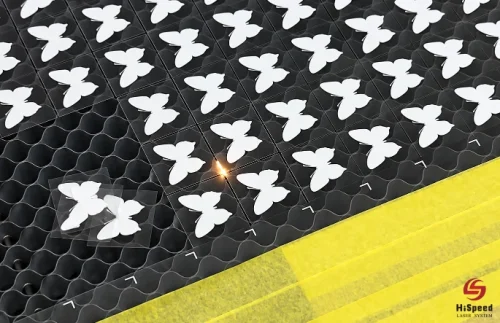
In heat transfer vinyl production, materials are often supplied as sheets or rolls, and designs frequently need to be nested across a relatively large processing area. If the working area is too small, the material must be repositioned repeatedly, which reduces efficiency and increases positioning errors.
For garment accessories, labels, sports numbers, and batch logo production, a large working area is especially valuable. More graphics can be nested on a single sheet, improving both material utilization and production efficiency.
A larger processing area also introduces another challenge: maintaining consistent focus from the center to the edges. If focal distance is unstable, line width, edge quality, and cutting depth may vary across different positions.
This is where a 3D dynamic focusing system becomes valuable. Software-controlled focal adjustment helps maintain more consistent energy distribution and cutting results across a larger working area. For thin and heat-sensitive heat transfer vinyl, focus stability directly affects edge cleanliness, graphic detail, and consistency from one batch to the next.
Therefore, the advantage of a large-format CO2 laser solution is not simply a larger processing area. More importantly, it helps manufacturers achieve more stable and repeatable quality in batch production.
Evaluating Laser Processing Requires More Than Checking Whether the Material Is Cut Through
When testing heat transfer vinyl, many users first check whether the design has been fully cut. For real production, however, that is only the most basic criterion. Edge quality is equally important. An ideal cut should be clean and precise, without obvious charring, burrs, excessively wide melted edges, or material shrinkage.
The next consideration is weeding performance. After processing, excess vinyl normally needs to be peeled away. If the cut is incomplete, weeding becomes difficult; if the cut is too deep, it may damage the carrier film or adhesive layer.
The third consideration is design accuracy. Brand logos, garment numbers, reflective graphics, and silicone labels often contain fine details, so variations in line width or contour accuracy can affect the final appearance.
The fourth consideration is transfer performance. Heat transfer vinyl must ultimately be heat-pressed onto apparel, footwear, bags, or other fabrics. If laser processing damages the adhesive layer or hardens the edges, it can affect adhesion, hand feel, and long-term durability.
In short, a reliable laser process for heat transfer vinyl must balance cutting quality, design accuracy, and stable downstream heat transfer performance. The appearance of the cut immediately after processing is only part of the evaluation.
Hispeed Laser Solutions for Heat Transfer Vinyl Engraving and Cutting
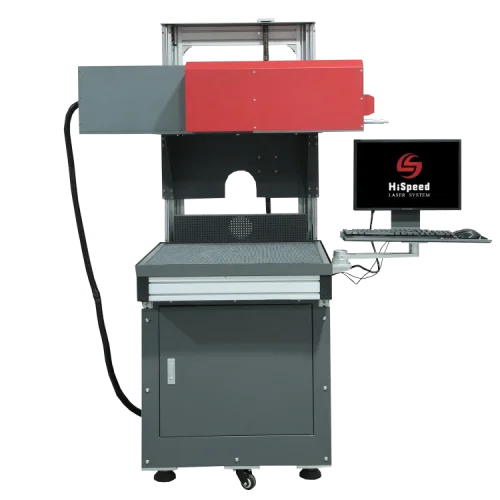
HispeedLaser provides large-format CO2 laser engraving and cutting solutions with working areas from 600 × 600 mm to 800 × 800 mm, suitable for batch nesting, complex graphic processing, and larger-area material handling.
The equipment uses a high-precision digital scanning system together with a 3D dynamic focusing system. Software-controlled focal adjustment helps maintain more consistent processing results across the full working area.
For different heat transfer vinyl materials, HispeedLaser can perform process testing based on customer samples and optimize laser power, speed, focal distance, processing path, and number of passes. This helps customers identify parameter combinations that are better suited to actual production conditions.
For customers requiring higher-volume processing, the system can also be further customized according to material size, graphic type, production takt time, and automation requirements, providing a solution better suited to continuous production.
Conclusion
Laser engraving and cutting for heat transfer vinyl is not simply about cutting through the material. A reliable process must account for material structure, design accuracy, edge quality, and downstream heat transfer performance.
For garment accessories, labels, sportswear, footwear and bags, and personalized customization applications, laser processing is becoming an important tool for improving flexible production capabilities.
A properly configured CO2 laser solution can help manufacturers achieve higher efficiency, finer design details, cleaner edges, and more stable batch-processing results.
When material structure, thickness, color, or transfer requirements are uncertain, sample testing remains a key step in confirming the appropriate laser process and equipment configuration.