
Laser marking is a well-established identification and processing technology in industrial manufacturing, product packaging, promotional products, and personalized customization. From metal components and plastic housings to glassware and paperboard packaging, different products have very different requirements for marking precision, processing speed, and surface finish.
The three main laser sources used for industrial marking are fiber, CO₂, and ultraviolet (UV) lasers. Each offers distinct advantages in wavelength, material compatibility, processing mechanism, and application. Choosing the right system should depend on material properties, process requirements, and production methods—not simply on which technology appears more advanced.
1. Key Differences Between the Three Laser Technologies
The fundamental differences between fiber, CO₂, and UV lasers lie in their wavelengths and how different materials absorb laser energy at those wavelengths.
Fiber Lasers: Metal Marking and Industrial Traceability
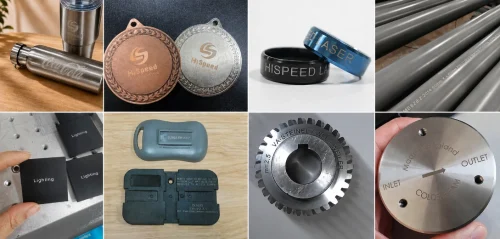
Fiber lasers operate at a wavelength of 1064 nm and are particularly well suited to metals such as stainless steel, aluminum alloys, carbon steel, brass, and titanium alloys.
They create clear, permanent marks through surface oxidation, color change, or ablation. Typical applications include logos, serial numbers, QR codes, deep engraving, and industrial traceability. Fiber lasers can also produce high-contrast marks on certain engineering plastics formulated with specific additives.
They are widely used for automotive components, hardware tools, electronic connectors, medical devices, and metal promotional products.
CO₂ Lasers: Nonmetallic Materials and Coating Removal
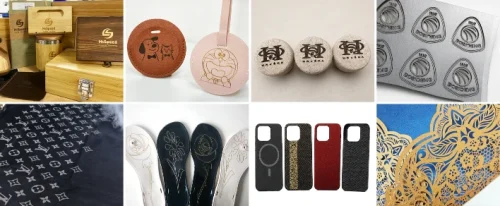
CO₂ lasers operate at a wavelength of 10.6 μm and are suitable for paper, wood, leather, acrylic, certain plastics, and various surface coatings.
In addition to conventional text and graphic marking, they can be used for engraving, coating removal, and cutting certain nonmetallic materials.
A typical example is marking powder-coated stainless steel tumblers. A CO₂ laser removes the coating in selected areas to reveal the underlying metal, forming logos and decorative patterns. This process is fundamentally different from using a fiber laser to engrave the metal itself. Equipment selection therefore depends on the intended result.
UV Lasers: Precision Marking with Minimal Heat Impact
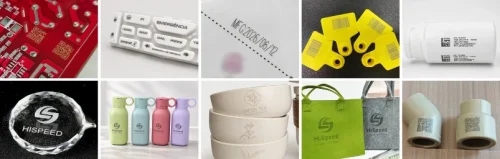
UV lasers operate at a wavelength of 355 nm, producing a fine spot size and a small heat-affected zone. They are especially suitable for precision plastics, glass, electronic components, and certain heat-sensitive packaging materials.
With appropriate settings, UV lasers can mark PC, PC+ABS, and certain PE and PP plastics while reducing the risk of thermal deformation, scorching, and surface damage.
For customized glassware, UV lasers can create delicate frosted finishes, making them a popular choice for premium gifts and branded products.
2. How to Choose a Laser for Different Materials
In real-world manufacturing, identifying the material is only the first step. Even the same base material can respond very differently to laser processing depending on its color, formulation, additives, and surface treatment.
| Material | Recommended Laser | Main Applications |
| Stainless steel, carbon steel, aluminum alloys | Fiber | Metal components, nameplates, hardware tools |
| Copper, brass, titanium alloys | Fiber | Connectors, precision metal parts |
| Paper, paperboard cartons | CO₂ | Packaging date codes, batch numbers |
| Wood, leather | CO₂ | Gift engraving, customized patterns |
| Acrylic | CO₂ / UV | Engraving, cutting, fine marking |
| Powder-coated metal tumblers | CO₂ / Fiber | Coating removal or engraving the base metal |
| PC, PC+ABS | UV / Fiber | Electronic housings, plastic buttons |
| PE, PP, PET | UV / CO₂ / Fiber | Packaging films, various plastic products |
| Glass cups and containers | UV | Frosted logos, designs on curved surfaces |
| Precision plastic electronic components | Fiber / UV | Text, QR codes, traceability codes |
Important: This table is intended only as an initial selection guide. Sample testing is essential to confirm material compatibility; the choice should never be based on material categories alone.
3. Higher Laser Power Is Not Always Better
Customers often ask: What is the difference between a 30 W and a 60 W fiber laser? How should they choose between a 5 W and a 10 W UV laser?
Laser power affects processing capability and throughput, but it does not determine marking quality on its own.
Fiber lasers: 30 W is sufficient for standard metal marking, including logos, text, QR codes, and serial numbers. 60 W is better suited to efficient batch production and light-to-moderate engraving. 100 W is commonly used for deep engraving, larger processing areas, and high-throughput production lines.
CO₂ lasers: Power should likewise be selected according to the material and required output. 30 W is suitable for standard nonmetallic marking; 60 W offers a balance of speed and processing capability; and 100 W provides greater power capacity for large-area engraving, coating removal, and high-volume customization of insulated tumblers.
UV lasers: Hispeed Laser recommends 5 W as the minimum configuration for industrial applications. For faster production cycles, larger marking areas, or more challenging materials, 10 W, 15 W, or higher-power systems may be appropriate.
However, higher power requires precise control of energy density and scanning speed to manage heat effects. On precision plastics, thin films, and glass, excessive power combined with unsuitable parameters can damage the workpiece and reduce production yield.
Other factors—including laser wavelength, pulse width, galvanometer scanning system, focusing lens, and beam quality—also influence the final marking result.
4. Match the Machine Configuration to the Production Process
Selecting the laser source and power does not complete the equipment selection process. Product geometry, marking area, and production-line operation are equally important.
For flat metal parts, plastic housings, and conventional gifts, a standard desktop laser marking machine is often sufficient. Cylindrical tumblers, glass bottles, and metal tubes may require a rotary axis to enable 360° circumferential marking.
For products with significant height variation or curved surfaces, a 3D dynamic focusing system can compensate for changes in focal distance to maintain consistent, clear marks. Complex items, such as irregularly shaped glassware, may also require 3D modeling to generate marking paths that follow the surface.
Continuous production is especially important in the packaging, pipe, and electronics industries. An online flying laser marking system uses sensors and encoders to synchronize with the production line and mark moving products, eliminating separate positioning, loading, and unloading steps.
When workpieces arrive in batches, vary in position, or require precise alignment, a CCD vision positioning system can automatically locate each part and compensate for positional offsets, reducing manual alignment errors.
Laser marking system selection is therefore about more than choosing a laser source. It means configuring a complete processing solution that fits the actual production workflow.
5. How to Identify the Most Suitable Laser Marking Solution
An effective laser marking solution must meet three requirements: material compatibility, marking quality, and production efficiency.
First, confirm that the material can achieve the desired result. Metal applications may require black or white marks, or a specified engraving depth. For plastics, the priorities are often contrast, edge quality, and minimizing heat damage. For glass, customers typically value a uniform frosted appearance, clear markings on curved surfaces, and crack prevention.
Second, evaluate whether the equipment can keep up with production-line cycle times. Producing a single sample in a laboratory is very different from processing thousands of parts continuously. Long-term equipment stability, fixtures, and automation capabilities become far more important in mass production.
Third, assess total long-term operating costs. Beyond the purchase price, consider processing efficiency, maintenance intervals, power consumption, fume extraction, and labor costs.
The real measure of a laser marking system is whether it can deliver consistent results in mass production—not whether it can successfully mark a single sample.
6. Hispeed Laser Marking Solutions
Hispeed Laser offers a comprehensive range of fiber, CO₂, and UV laser marking machines, along with customized automation solutions for different materials and production environments.
Depending on the required engraving depth, processing speed, and surface finish, systems can be equipped with 3D dynamic focusing, rotary axes, and CCD vision positioning to handle flat parts, curved workpieces, and high-volume industrial components.
Before purchasing, customers can send samples to Hispeed Laser for testing with different laser sources and process parameters. We evaluate marking clarity, contrast, processing speed, and potential material damage to help identify the most suitable machine configuration.
Conclusion
Fiber, CO₂, and UV lasers are not inherently better or worse than one another. The key is to match the laser source to the application.
For manufacturers, choosing a laser marking system is not simply a matter of buying the highest-powered machine. It is about finding a solution that consistently delivers the desired results over the long term in mass production.
From sample testing and laser source selection to automation integration, the right process configuration is essential for stable operation and greater production efficiency.
If you have parts that need laser marking trials, contact Hispeed Laser to submit your samples and receive a free process evaluation and solution recommendation.