
In the automotive field, precision is extremely important. From millimeters to nanometers, the processing should be precise. Among many production requirements, accurately marking auto parts is one of the most important. In this area, the fiber laser marking machine plays a vital role.
Fiber laser marking machines are especially popular in the automotive industry. They are used for metal engraving, etching, and marking. You can use them to mark various components, including powertrain systems, transmissions, and chassis components.
In this article, we will discuss fiber laser marking for automotive parts in detail. We will also explore which components can be marked using a fiber laser marking system. Most importantly, we will discuss how to choose the right machine for your needs.
What Is Fiber Laser Marking for Automotive Parts?
A fiber laser marking machine is a high-end tool for labeling auto parts. It uses a highly focused laser beam to engrave the material surface or change its properties. Using this technology, you can create a wide range of designs on metal parts. It could be a logo, serial number, or code.
Another crucial advantage of using fiber laser marking is its versatility. It works on all types of regular metals we use, including aluminum and steel.
In 2026, fiber laser marking use in the automotive sector increased dramatically. The use of stickers or chemical printing makes it messy and increases production costs. Fiber laser marking for automotive parts is a clean, efficient process.
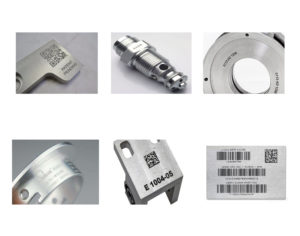
Common Automotive Parts Marked with Fiber Lasers
Fiber laser marking is widely used to create permanent and precise marks. Different vehicles come with different components. Each component needs laser markings for traceability, safety, and compliance. From engine parts to electronic modules, there are hundreds of thousands of parts.
| Automotive | Common Components |
| Powertrain | Engine blocks, pistons, fuel injectors, turbochargers |
| Transmission | Gearboxes, clutch parts, transmission housings |
| Chassis | Frames, suspension parts, axles, steering components |
| Safety Systems | Airbag modules, brake systems, seatbelt parts, sensors |
| Electronic Modules | ECUs, sensors, connectors, control modules |
Common Applications of Fiber Laser Marking for Automotive Parts
Fiber laser machines have a wide application in the automotive industry. It offers endless possibilities, from barcodes and QR codes to texts, designs, and more. We have categorized these uses into five main groups.
Identification & traceability
Fiber laser marking machines create permanent marks on chassis or engine blocks. As mentioned before, these marks can be VINs and serial numbers. These marks ensure each part is unique and holds an identity. It allows manufacturers to track the products throughout the entire production process.
Coding & Data Management
You can also use fiber laser marking to create a QR code or a data matrix code. These codes are essential for quick scanning and retrieving data. During packaging or storage, these QR codes help a lot and speed up the process.
The QR code may also save time and data, as well as other product details. It allows you to maintain the manufacturing logs properly. Overall, such data ensures perfect accuracy and improvement for a factory.
Compliance and Safety Marking
One of the crucial concerns for an automotive part is meeting strict production rules and protocols. If parts have met with standard protocols, it must be mentioned. Here, desktop fiber laser marking machines help to create compliance symbols and safety codes. You may also use it on seatbelts, airbags, and others.
Branding & Anti-Counterfeiting
Many car brands use laser marking systems to create aesthetically pleasing logos on the surface. Using this technology, they create hidden anti-counterfeiting marks on the expensive spare parts. These hidden or micro-marks are proof of the product’s genuineness. It determines whether the part is authentic. This way, it protects the manufacturer’s reputation.
Surface & Functional Processing
Beyond etching text, lasers can also produce functional marks. It improves oil retention and grip quality. Typically, makers create specialized surface textures on engines to reduce friction and increase efficiency. It can also create patterns to improve adhesiveness in bonding. Thus, you can enhance the performance. It is an easy way to modify the surface without chemicals.
Fiber Laser Marking Techniques Used in Automotive Manufacturing
Many types of markings can be created using a fiber laser marking machine. From deep engraving to black marking, even color marking is possible. Each of these techniques is used for specific parts depending on the application and requirements.
Deep Engraving
For deep engraving, fiber lasers are a perfect solution, especially for metals. They remove materials from the surface to create a cavity that lasts for a long time. Each mark remains readable after painting or enduring extreme wear.
Annealing
The annealing method uses heat as the main energy source to alter the surface texture. It changes the surface color without removing material. Stainless steel is the most suitable metal used in this process. During the process, it maintains a smooth surface and prevents rust and corrosion.
Black Marking
Black marking produces a dark mark on the metal surface, like aluminum. For this work, you will need a specific setting configuration to create a non-reflective mark. These marks are permanent and can withstand wear and tear.
Surface Etching and Frosting
Surface etching begins by melting the top layer of the product to create a frosted appearance. Manufacturers use it for mostly interior plastic buttons or logos. It’s a perfect way to promote brands and companies.
Color Marking
Color marking utilizes small, controlled pulses to produce marks on titanium or chrome. Temperature plays a prominent role here. Using different temperatures allows you to generate different colors. This practice adds a premium, glossy look to automotive trim.
Best Fiber Laser Marking Machine for Automotive Parts
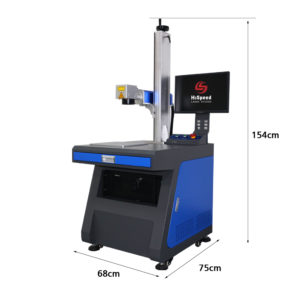
The Hispeed Desktop Fiber Laser Marking Machine is an excellent choice for automotive precision. It includes a high-quality Rycus or JPT laser source that has a 100,000-hour lifespan. Marking speed reaches up to 7,000 mm/s and can create a 0.01 mm line width. Its ±0.01 mm repeatability is also a significant advantage.
Overall, it’s a versatile option that serves in automotive, electronics, and hardware sectors. Besides, it can also handle a wide range of materials, including steel, aluminum, and plastics. Each power option provides a specific etching depth. Moreover, it features an air-cooling system that keeps the machine running for extended periods. Overall, it’s a one-stop solution.
How To Choose the Right Laser Marking Machine for Automotive Parts
Not all laser markers produce the same quality output. Not all fiber lasers might be suitable for marking all metals. There are limitations and opportunities for different types of marketing. Therefore, when choosing the right laser marker, it is crucial to consider a few factors.
Material Type
Generally, different metals react uniquely to different wavelengths. Hard steels require more power than aluminum. Although aluminum transmits heat quickly, you may also need to consider this factor. Therefore, always test your metal first for better marking quality.
Mark Depth and Visibility
Make sure whether you need deep engraving or surface annealing. Deep marks are suitable for parts that later get painted. Annealing is suitable for preventing rust and making the surface smooth.
Production Speed
For high-volume production, you might need a speedy galvometer scanner. Ensure your production line requirements meet the speed. Otherwise, you may not meet the deadline.
Automation Options
Always choose a machine that supports automation. It should integrate with robotic arms or conveyors. Also, check the software compatibility for better performance.
Environmental Exposure
Always consider that the mark may endure extreme heat or other harsh conditions. During application, it may come into contact with harsh chemicals, salt, friction, or extreme heat. For this reason, choose a laser that confirms the lifetime mark.
Compliance Requirements
Verify whether the machine complies with all international standards and protocols. Marking quality must pass the industrial scanning test. Reliable traceability is required for legal safety.
Best Fiber Laser Marking Machine Supplier: Hispeed Laser
Hispeed Laser is a top company that makes laser machines and specializes in marking. The company makes high-performance tools known for their durability and usefulness. You can use them in many areas. Medical, shipbuilding, automotive, aircraft, and many other fields are examples. Their methods use top-notch tools that can work on a wide range of automotive materials.
The company offers exceptional technical support and after-sales services. You can gather real-time knowledge from the websites. It will help you reach out to real news. You may also check the customer reviews. Their main goal is to generate new ideas.
Conclusion
So far, we have briefly discussed how the fiber laser marking machine serves in the auto industry. It mainly creates five types of surface marks. You can deep engrave, anneal, mark, etch, frost, or even color mark. Although many people use MOPA-featured fiber laser marking machines for color marking.
Choosing the right machine for laser marking auto parts is crucial. Not all laser markers deliver the same quality output. You must consider various factors as mentioned in this article. To make your research much easier, we have also introduced the best fiber laser marking machine in 2026.
YLP-20L/30L/50L/100L can adopt an advanced fiber laser source. It is a versatile device. It is especially well-suited for the automotive industry. HiSpeed Laser is a leading manufacturer of a wide range of laser devices. If you are interested in fiber laser marking machines, feel free to reach out to our customer support team.