
Metal marking is an important method for adding logos, marks, guidelines, or slogans to various metal parts. These markings are done using different methods. These include laser marking, etching, dot peen marking and so on. However, these markings start to fade over time. This raises the question: Why do metal markings fade after production?
When the mark fades, it looks awful, affecting the visual appeal of that part. Sometimes, important information marked undergoes fading. This affects the readability of marks, such as guidelines for using the parts. If guidelines disappear due to fading, customers get no proper information about the part. In this article, I will discuss the major reasons why markings can fade and disappear. Let’s get started.
Why Do Metal Markings Fade After Production?
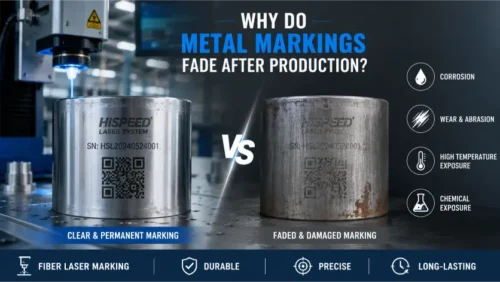
Interestingly, the fading of metal markings is not caused by a single factor. Instead, multiple reasons can cause fading of marks (logo, slogan, guidelines). Understanding all of these reasons is crucial to avoid the issue in the future. In the section below, I will discuss the major reasons metal markings fade.
1- Incorrect Marking Method
Wrong marking methods are a major contributor to the fading of marks on metals. Many people use ink printing or etching to mark their parts. Initially, marks made by these methods look sharp. However, things get worse over time when marks are exposed to heat, humidity and other environmental conditions. That’s why I recommend choosing laser marking to create high-quality marks. Such marks are so durable that they don’t even fade after many years. Remember, laser marking machines must have deeper marks, not shallow ones.
2- Improper Surface Preparation
Surface preparation is one of the most overlooked steps in metal marking. There can be contaminants on metal surfaces. These include grease, oil, corrosion buildup, and more. Creating marks on such surfaces will result in marks that are too weak. Such weak marks will deteriorate and fade over time. Instead, you should always prepare and clean the surface before starting the marking process. I recommend using a brush and removing the rub surface to carefully remove the contaminants. Marks made on a clean surface will be long-lasting and won’t fade.
3- Corrosion & Mechanical Wear and Abrasion
Corrosion and abrasion also contribute to the fading of the marking. When metal parts corrode due to exposure to moisture or humidity. This corrosion breaks down the parts and deteriorates the markings. Similarly, continuous abrasion also affects the visual appeal of the parts. Ideally, you should keep the marked parts away from moisture. Additionally, you can also apply a thin coat of paint on parts to make them corrosion-resistant. Our fibre laser marking machine helps create abrasion-resistant markings. Continuous abrasion, friction, or rubbing can wear down the marks.
4- High Temperature & Humidity (Moisture) Exposure
Metal markings are sensitive to high temperatures. Why? The reason is that heat causes oxidation on the metal surface. This oxidation affects the surface, which reduces the clarity and visibility of the markings. If parts remain exposed to high temperatures, the marking can disappear completely over time. As I said above, moisture causes corrosion on the metallic parts. This corrosion affects metal surfaces, causing the markings to break down. Ideally, you should keep the metal away from high temperatures and moisture.
5- Wrong Material Type & Post-Processing
There are different types of metals and alloys used in modern manufacturing. However, these materials behave differently under laser marking. Some metals are softer and do not retain the markings for as long. On the other hand, there are other materials which are robust and hold the markings. Softer materials require specific settings on marking machines. If the piece has paint or has been sandblasted, the markings may not remain permanent. Post-processing should be done carefully. One wrong step can cause the markings to fade and disappear.
6- Wrong or Low Quality Equipment
Metal marking must be of a specific depth. If these markings are shallow, they are more likely to fade over time. Unfortunately, low-quality laser marking machines are available. However, they create patterns or markings of lower depth. As a result, the markings start to fade over time. Therefore, it is important to use high-quality laser marking machines. Remember, this is true for all types of equipment. No matter whether you are using ink printing, etching or other methods, prefer quality equipment. This will help you create metal markings that last longer and don’t fade.
7- Oxidation of Metal Surface & Chemical Exposure
Oxidation of metals is quite common, irrespective of the metal type. It happens at a slow rate in some and at a faster rate in others. Oxidation happens when a metal reacts with air. This reaction breaks down the surface of metals. This can result in deterioration of the metal surface, causing metal markings to fade. Similarly, if metal is exposed to harsh chemicals, the surface layer can still deteriorate. As a result, the metal marking is significantly affected. Common chemicals that metallic parts are exposed to include acids, solvents, and so on.
Practical Tips for Protecting the Metal Markings from Fading
Fading of metal markings can be frustrating, right? However, this issue can be avoided by properly caring for your metal parts. Here are some effective tips you can follow to protect your parts from fading:
- First, you should use laser marking machines that offer better marking depth. More depth ensures that marks remain visible for longer and don’t fade.
- It is not advisable to mark the metal part without pre-treating the surface. Instead, you should always clean the surface before marking it. If you notice any contaminants, remove them for better marking adhesion.
- There is a wide range of metal marking machines available in the market. Each of these marking machines differs from the others in its operation. You should choose the right machines that are compatible with specific material types.
- UV rays can affect the marking, regardless of how it is made. Therefore, it is best to keep the metallic part protected from these rays. Additionally, you should minimise rubbing of the part when handling or carrying it.
- People make the mistake of marking before post-processing. This is wrong: you should perform post-processing first. Once done, you can mark the part as part of the finishing process. This way, your marking will remain protected, since it could fade during post-processing.
Conclusion
Let’s conclude – metal markings are effective ways to identify different metallic parts. Manufacturers use markings to apply logos, brands, slogans, or expiry dates to parts. In fact, these markings are best to show guidelines or warnings on the parts. So if the markings fade, this can be a serious concern for the manufacturers. Customers may not be able to read important information and could make mistakes.
There are different reasons which can cause the fading of metallic markings. In this article, I discuss seven major reasons which you must know. In the final section, you’ll get tips to prevent these fading issues. Remember, we offer fibre laser marking machines that produce markings resistant to wear and abrasion. If your metal part is exposed to abrasion, choose our machine to achieve long-lasting markings.