
A technical article on selective coating removal, process window control, and mass-production consistency
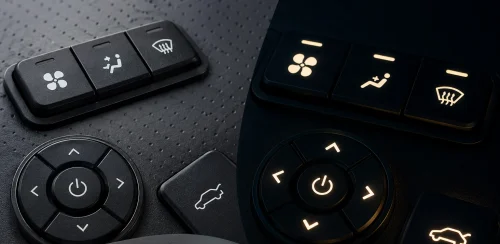
Plastic backlit buttons, also known as backlit keypads or Day & Night Design components, are common in many areas. They are widely used in automotive electronics, smart home devices, industrial controls, and consumer gadgets. During the day, the button surface stays uniform and clean. At night or in low light, backlighting shines through the characters or patterns. This makes the indications clear and easy to see.
This effect may look simple, but the manufacturing process behind it is far from simple. Many people see laser-backlit marking on plastic buttons as “using a laser to remove the black paint.” From the final result, this statement is not entirely wrong. However, from an industrial production perspective, the real challenge is not simply removing the coating. The real difficulty is removing the specified coating layer precisely without damaging the transparent layer or the plastic substrate underneath, while maintaining stable, consistent backlighting results in mass production.
Process Essence: Not Plastic Engraving, but Selective Coating Removal
Plastic backlit buttons usually use transparent or semi-transparent polymers as the base material, such as PC, ABS/PC engineering plastics, and some silicone elastomers. Depending on the product structure and visual requirements, one or more functional or decorative coating layers are usually sprayed onto the substrate surface. Common structures include a light-transmitting or diffusion color layer, an opaque blocking layer, and a protective layer.
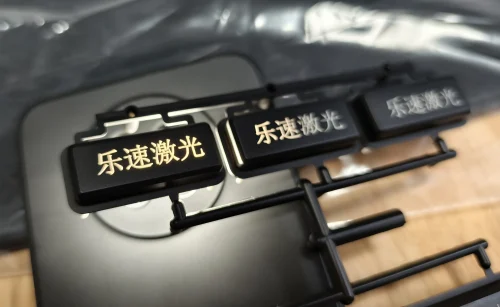
Laser processing does not directly engrave the plastic substrate. Instead, it selectively removes the opaque coating in the target area according to the preset characters or patterns. This exposes the light-transmitting material or light-transmitting layer underneath, creating the final Day & Night backlighting effect.
Therefore, laser backlit marking on plastic buttons is precision selective processing on a multi-layer material structure. It involves not only the laser machine itself but also matching the substrate, coating, color, thickness, backlighting structure, and mass-production stability.
How Does the Laser Remove the Coating?
When the laser acts on the button surface, the target coating first absorbs the laser energy. After absorbing energy, the coating can be removed. This can happen through localized photothermal ablation, material vaporization, or photochemical effects. The specific mechanism depends on the laser wavelength, pulse width, energy density, and the coating material itself.
When you consider a single processing action, removing a paint layer is not difficult. Increasing power, reducing scanning speed, or adding more passes can all increase material removal. However, the key to backlit button marking is not “removing more,” but “removing only the layer that should be removed.”
This is also why some samples may look easy to produce, but problems often appear in mass production. Creating one character in a lab is not difficult. The real challenge is keeping character edges, backlight brightness, color consistency, and substrate condition stable during long-term production.
The Real Challenge: Selective Removal
The technical core of laser backlit marking on plastic buttons is selective removal. In other words, the laser must completely remove the target opaque coating. Meanwhile, it should affect the light-transmitting layer or plastic substrate underneath as little as possible.
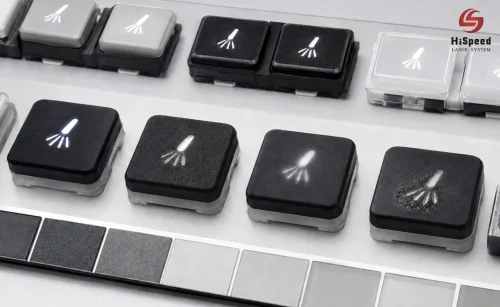
If the laser energy is insufficient, coating residue may remain. The character area may show dark spots, gray marks, uneven light transmission, or incomplete edges. When the backlight is on, these defects stand out more. They can impact how the product looks and how users feel about it.
If the laser energy is too high, the problems are obvious as well. For example, the plastic substrate may melt, yellow, deform, pit, or become rough. Character edges may expand. The light-transmitting area may become uncontrolled. And even the backlight color and brightness may change. For automotive interiors, appliance panels, or high-end electronic products, these defects can directly reduce product quality.
So this process doesn’t need a simple parameter that answers, “Can the paint be removed?” It needs a stable process window: the target coating can be removed consistently without visibly damaging the underlying material.
Why Is the Process Window So Narrow?
Many parameters affect the process window for backlit button marking. These include laser wavelength, pulse width, single-pulse energy, frequency, marking speed, hatch distance, number of passes, and focus position. Changing any parameter may affect coating removal, character edge quality, backlight brightness, and batch-to-batch consistency.
For example, if the scanning speed is too high, the coating may not be removed completely. If the speed is too low, heat can build up locally. If the hatch distance is too large, stripes or uneven light transmission may appear inside the character. If the hatch distance is too small, over-processing may occur. Focus position deviation can also change the energy density and cause inconsistent depth or brightness within the same production batch.
For this reason, a backlit button process cannot be considered mature just because the surface paint has been removed. It should be checked against five points:
- Whether the coating is removed cleanly
- Whether the substrate remains undamaged
- Whether the backlight is uniform
- Whether the edges are sharp
- Whether the process can be repeated consistently in mass production
Material and Coating Uncertainty Is a Key Variable in Mass Production
Another issue that is often underestimated in plastic button processing is that materials and coatings are not always stable. Even if two materials are labeled PC or ABS/PC, suppliers may use different formulations. They might have varying additive ratios, color systems, and light-transmission properties.
Coatings are the same. Spray thickness, paint type, opacity, color, and protective-layer hardness all affect laser absorption and removal behavior. The same laser settings might work for one button. However, when you switch to a different coating system, you might see problems like low light transmission, blurred edges, or even substrate damage.
That’s why you can’t determine the right process solution for plastic backlit buttons based on the material name alone. The reliable approach is to test the actual samples. Then optimize parameters. This helps find the right processing window suitable for that specific substrate and coating combination.
UV Laser or Fiber Laser? The Key Is Material Response, Not the Name
In laser-backlit marking on plastic buttons, no single laser technology fits every product. Both UV lasers and fiber lasers have their own application spaces.The final selection should be based on substrate, coating material, coating color, coating thickness, backlighting quality requirements, and production cycle time.
A 355 nm UV laser usually provides strong precision processing capability. So it is a better choice for heat-sensitive plastics, fine characters, and applications where heat impact must be minimized. Additionally, its heat-affected area is relatively small, making it better suited for plastic parts that require a high-quality appearance, clean edges, and fine details.
However, in automotive interior buttons and Day & Night backlighting design, 1064 nm fiber lasers, including some MOPA fiber solutions, are also used for precision paint removal on coated plastic parts. Their advantages include:
- High efficiency
- Wide parameter adjustment range
- Good processing adaptability for certain coating systems
So the right question isn’t “Which laser must be used for plastic buttons?” It is: “Which laser wavelength and parameter combination provides the most stable response for this specific substrate and coating structure?”
From Sample Testing to Mass Production, Consistency Is the Real Test
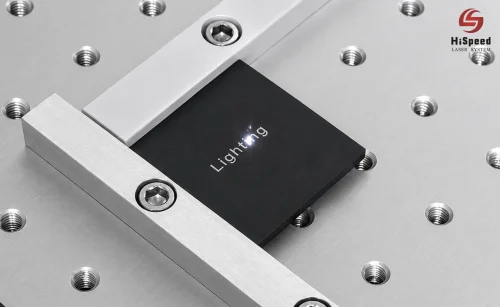
Sample testing for plastic backlit buttons is usually only the first step. Industrial customers care most about whether the machine can maintain consistent results in continuous production. A great sample character doesn’t guarantee the whole batch will have the same edge quality, brightness, and light uniformity.
In mass production, several factors can impact the final result. These include:
- Product positioning
- Fixture stability
- Focus height
- Coating batch variation
- Ambient temperature
- Production cycle time
For curved buttons or irregular parts with obvious height variations, you must also consider how focus change affects energy density.
Therefore, a mature backlit marking solution usually requires not only a suitable laser source, but also vision positioning, stable fixtures, a parameter database, and batch testing. Only by combining materials, equipment, process control, and production management can you achieve truly repeatable mass-production capability.
From Sample Testing to Stable Mass Production: Hispeed Laser’s Process Solution
For plastic backlit buttons, automotive interior buttons, appliance control panels, industrial buttons, and similar applications, HispeedLaser cares about more than just “can it be marked.” We help customers find a stable and mass-producible process window.
In real projects, we start by looking at the customer’s sample. We focus on five points:
- Substrate: what material the product is made of
- Coating structure: whether the surface has a coating and how many layers
- Character size: how small and how fine the marks need to be
- Backlight requirement: whether the characters need to let light through
- Production cycle time: how many parts the line must mark per minute
After the evaluation, we decide whether a UV laser or a fiber laser is a better choice. We then use sample testing to confirm four things. These include coating removal quality, substrate damage, character edge quality, and backlight consistency.
For small plastic parts with high precision or strict positioning, we can add a vision positioning system to improve processing consistency. For curved products or parts with clear height variations, we evaluate dynamic focusing solutions to reduce quality variation caused by focus changes.
Conclusion
The real difficulty of laser backlit marking on plastic buttons is not simply removing the paint. Product quality relies on carefully removing the target coating. This must be done without harming the light-transmitting layer or the plastic substrate below.
A good backlit marking process must achieve clean coating removal, no obvious substrate damage, uniform backlighting, sharp character edges, and stable batch results. For automotive electronics, smart home appliances, industrial control equipment, and consumer electronics, this is no longer just a marking process. It is a key manufacturing process that determines product appearance, function, and reliability.
If customers are unsure whether a certain plastic button is better suited to UV laser or fiber laser, sample testing is usually the first step in confirming the process route and machine configuration.